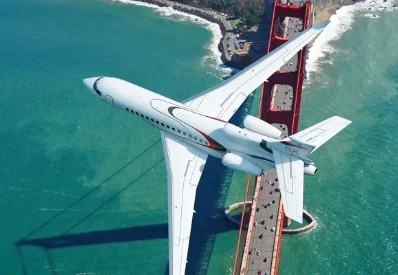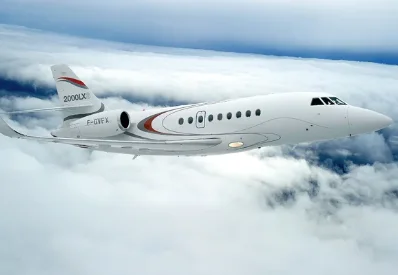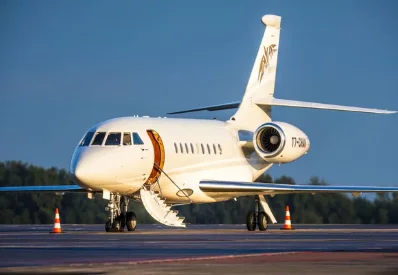
Dassault Falcon 900LX
Dassault delivered the first production Falcon 900LX in 2010 as a replacement for the 900EX. It is fitted with a variety of upgrades, including new wing designs and three new turbofan engines, which serve to increase its overall performance, particularly in terms of its fuel efficiency and range, which has risen to 8,800 km. These improvements, combined with the recognisable and effective profiled winglets, also explain the maximum cruise speed of the Falcon 900LX, which is greater than both the Bombardier Challenger 850 and the Global 5000. Much like the 900DX, this aircraft is categorised as a Super Large Business Jet and offers the same extra-wide and long fuselage, similar in size to that of the flagship Falcon 7X. The modern interior is split into three separate zones and can seat up to 13 passengers and is not just spacious, but also luxurious and features Wi-Fi and an MP3 system to provide an enjoyable journey. Comfortable, efficient and capable of connecting major cities, such as Paris and Beijing or New York and Moscow, the Falcon 900LX is a fantastic option for your flight.
Large Jet
| Specification | Value |
|---|---|
| Manufacturer | Dassault |
| Category | Large Jet |
| Range* | 8797 km 4750 NM |
| Cruise speed | 878 km/h 474 kts |
| Seats** | 12 |
| Suitcases | 12 |


* with IFR reserves
** in standard configuration
Aircraft Pictures

History
Dassault announced the Falcon 900LX at EBACE 2008 as the latest evolution of the trijet family, incorporating high-mach blended winglets designed by Aviation Partners Inc. The LX represented the culmination of over two decades of 900 series development.
The aircraft achieved EASA and FAA certification in July 2010, following extensive testing of the winglet integration. The winglets provided a 7% range increase over the 900EX, extending capability to 4,750 nautical miles.
As the current production variant, the 900LX combines the proven TFE731-60 engines with aerodynamic improvements and modern avionics systems. The aircraft maintains the three-engine configuration's operational advantages while delivering enhanced fuel efficiency.
The 900LX represents the latest chapter in the Falcon 900 story, with over 500 aircraft now in operation across all variants. The aircraft continues Dassault's commitment to the trijet concept, offering unique capabilities in airport access, safety margins, and operational flexibility that distinguish it from twin-engine competitors.
Technical Specifications
General information
| Model name | Falcon 900LX |
|---|---|
| Manufacturer | Dassault Aviation |
| Aircraft category | large jet |
| ICAO Designator | F900 |
| Start/End of Production | 2010 - Still in production |
| Number of pilot(s) | 2 |
Performances
| Range (with IFR reserves) | 4750 NM (8797 km) |
|---|---|
| Ferry range | 5466 NM (10123 km) |
| Cruise speed | 474 kts (878 km/h) |
| Max Operating Speed – VMO | 370 KIAS |
| Max Mach Operating Speed - MMO | Mach 0.87 |
| Long-Range Cruise Speed - LRC | 459 KTAS |
| Approach Speed | 110 kts |
| Takeoff Distance | 1633 m |
| Average Landing Distance | 735 m |
| Service Ceiling | 51000 ft |
| Thrust | 5000 lbf |
Aircraft technology
| Engine type | Turbofan |
|---|---|
| Engine(s) | 3 x Honeywell TFE731-60 |
| Avionics | EASy II (Honeywell Primus Epic) |
Dimensions and capacity
| Aircraft length | 20.21 m |
|---|---|
| Aircraft height | 7.67 m |
| Wing span | 21.38 m |
| Cabin height | 1.88 m (6.17 ft) |
| Cabin length | 10.11 m (33.2 ft) |
| Cabin width | 2.34 m (7.67 ft) |
| Baggage volume | 3.6 m3 |
| Seats (standard config) | 12 |
| Seats (max) | 19 |
| Suitcases | 12 |
| Carry-on luggage | 10 |
| Maximum TakeOff Weight - MTOW | 22225 kg |
| Maximum Landing Weight - MLW | 20185 kg |
| Fuel capacity | 12586 L |
FAQ
Does the Falcon 900LX have more range than the Falcon 7X?
No, the Falcon 7X has significantly more range than the Falcon 900LX. The 900LX achieves 8,797 km (4,750 nautical miles) range, whilst the Falcon 7X can fly approximately 11,019 km (5,950 nautical miles). Both aircraft share Dassault's distinctive trijet configuration with three engines, but the 7X offers superior range capability due to its larger size and more advanced design.
What is the cruise speed of the Falcon 900LX?
The Falcon 900LX cruises at 878 km/h (474 knots), positioning it amongst the faster aircraft in the large jet category. This speed capability, achieved through aerodynamic enhancements including blended winglets and proven TFE731-60 engines, enables efficient transcontinental travel whilst maintaining the operational advantages of Dassault's trijet configuration.
What is the range of the Falcon 900LX, and which city pairs can it connect nonstop?
The Falcon 900LX has a range of 8,797 km (4,750 nautical miles), with ferry range extending to 10,123 km (5,466 nautical miles). This capability comfortably enables nonstop flights such as London to Singapore or New York to Dubai, making the aircraft well-suited for intercontinental business missions across major global routes.
How many passengers can the Falcon 900LX accommodate?
The Falcon 900LX typically seats 12-14 passengers in its standard configuration, with maximum capacity reaching 19 passengers depending on the interior layout. The spacious cabin measures 10.11 metres in length, 2.34 metres in width, and 1.88 metres in height, divided into three separate zones that provide flexibility for various seating arrangements, work areas, and relaxation spaces during long-haul flights.
What makes the Falcon 900LX's trijet configuration unique compared to twin-engine competitors?
The Falcon 900LX maintains Dassault's distinctive three-engine configuration, providing exceptional operational flexibility and safety margins compared to twin-engine aircraft. This design enables access to airports with restrictive approach profiles that twin-engine jets cannot reach, offers superior performance at high altitudes and hot temperatures, and provides redundancy that allows continued flight even with engine failure. The trijet layout also contributes to the aircraft's ability to maintain climb performance in challenging conditions whilst offering quieter cabin environment through balanced engine placement.