Bombardier Challenger 605
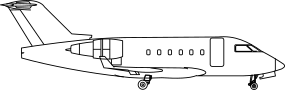
The Challenger 605 succeeded the 604 in 2006 to become Bombardier's flagship Large jet. It features a 14% increase in window size over its predecessor, allowing for more than a 30% increase in cabin natural light and providing passengers with an even better view. It has also received upgrades to its operating system and design. The addition of sleek winglets not only makes it easily distinguishable from the 604, but also, along with engine upgrades, serves to boost performance. Consequently, the Challenger 605 offers an even greater range than the 604, as well as being more efficient. It offers the same extra-wide cabin, seating 10 passengers in optimum comfort, and its modern noise reduction and stabilisation technology ensure a smooth and quiet journey. Overall, the Challenger 605 has a much more contemporary feel than its predecessor and balances comfort with performance to provide an excellent service.
Large Jet
| Specification | Value |
|---|---|
| Manufacturer | Bombardier |
| Category | Large Jet |
| Range* | 6856 km 3702 NM |
| Cruise speed | 870 km/h 470 kts |
| Seats** | 10 |
| Suitcases | 12 |


* with IFR reserves
** in standard configuration
Aircraft Pictures


History
The Challenger 605 emerged as a direct development of Bombardier's successful Challenger 604, introduced ten years after the 604's debut in 1995. The 605 made its first flight in January 2006, incorporating lessons learned from the 604's operational history.
Key improvements included larger cabin windows positioned higher on the fuselage, a new tail cone design, and redesigned interior providing more headroom and cabin volume. The aircraft also featured increased payload capacity of 91 kilograms compared to its predecessor.
The 605 received a significant avionics upgrade with the Rockwell Collins Pro Line 21 system, including electronic flight information system (EFIS), engine indication and crew alerting system (EICAS), and Bombardier's enhanced vision system (EVS). The cockpit also featured electronic flight bag capability.
Transport Canada conducted operational evaluations in August and September 2006, leading to certification by Transport Canada, EASA, and the FAA in October 2006. The aircraft entered service in January 2007. Production continued until 2016, with 290 aircraft manufactured before being replaced by the Challenger 650, marking the end of an era for this successful large-jet platform.
Technical Specifications
General information
| Model name | Challenger 605 |
|---|---|
| Manufacturer | Bombardier |
| Aircraft category | large jet |
| ICAO Designator | CL60 |
| Start/End of Production | 2006 - 2016 |
| Number of pilot(s) | 2 |
Performances
| Range (with IFR reserves) | 3702 NM (6856 km) |
|---|---|
| Ferry range | 4020 NM (7445 km) |
| Cruise speed | 470 kts (870 km/h) |
| Max Operating Speed – VMO | 348 KIAS |
| Max Mach Operating Speed - MMO | Mach 0.85 |
| Long-Range Cruise Speed - LRC | 424 KTAS |
| Approach Speed | 132 kts |
| Takeoff Distance | 1780 m |
| Average Landing Distance | 892 m |
| Rate of Climb | 4345 ft/min |
| Service Ceiling | 41000 ft |
| Thrust | 8729 lbf |
Aircraft technology
| Engine type | Turbofan |
|---|---|
| Engine(s) | 2 x General Electric CF34-3B |
| Avionics | Rockwell Collins Pro Line 21 |
Dimensions and capacity
| Aircraft length | 20.85 m |
|---|---|
| Aircraft height | 6.3 m |
| Wing span | 19.6 m |
| Cabin height | 1.86 m (6.1 ft) |
| Cabin length | 8.66 m (28.42 ft) |
| Cabin width | 2.49 m (8.17 ft) |
| Baggage volume | 3.26 m3 |
| Seats (standard config) | 10 |
| Seats (max) | 12 |
| Suitcases | 12 |
| Carry-on luggage | 10 |
| Maximum payload | 2200 kg |
| Maximum TakeOff Weight - MTOW | 21863 kg |
| Maximum Landing Weight - MLW | 17237 kg |
| Fuel capacity | 9005 L |
FAQ
How does the Challenger 605 compare to its successor, the Challenger 650?
The Challenger 650, introduced in 2015, brought more powerful engines, refined cabin styling, and enhanced avionics compared to the 605. While both share similar cabin dimensions, the Challenger 650 extends range to 7,408 km (4,000 nm) compared to the 605’s 6,856 km (3,702 nm). The 650 also provides slightly improved performance and passenger comfort. The Challenger 605 remains a cost-effective alternative, delivering long-range capability and comfort at a lower charter price point.
How does the Challenger 605 compare to the Falcon 2000?
The Challenger 605 offers a wider cabin, providing more interior space and comfort than the Falcon 2000. In terms of range, the Challenger 605 flies up to 6,856 km (3,702 nm), which is similar to or slightly less than the Falcon 2000’s later variants (such as the 2000LXS at around 4,000 nm). The Falcon 2000 is generally more fuel efficient, while the 605 prioritises cabin space and comfort.
How far can the Challenger 605 fly without refuelling?
The Bombardier Challenger 605 has an NBAA IFR range of 6,856 km (3,702 nm). This capability allows nonstop connections such as London to New York or Dubai to Geneva, depending on weather, payload, and passenger count. Its range makes it particularly attractive for transatlantic and intercontinental flights.
What makes the Challenger 605 different from the previous versions of the 600 series?
The Challenger 605 introduced significant updates compared to earlier 600 series models, especially the 604. It featured Collins Pro Line 21 avionics with four large displays, improving cockpit functionality and safety. Passengers benefited from redesigned interiors, larger windows, and modernised seating arrangements. These upgrades delivered a brighter cabin, improved connectivity, and enhanced operating efficiency while maintaining the series’ proven reliability and long-range capability.