Bombardier Challenger 850
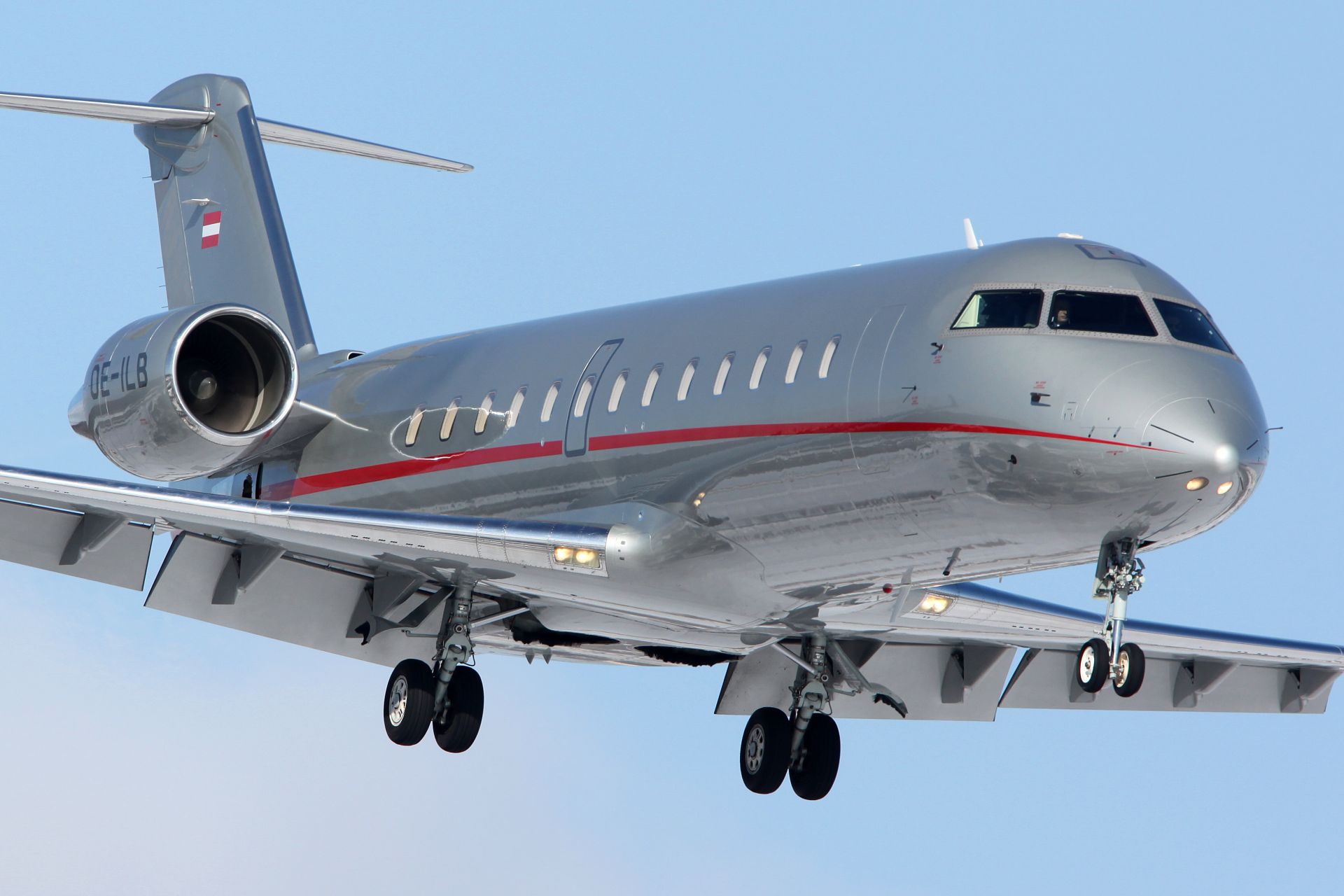
Bombardier's Challenger 850 is based on the CRJ200 and is one of the Canadian manufacturer's midsize jets. It surpasses the 600 series with a significantly longer cabin. Also known as the CL850, the jet offers a higher operating weight with a slightly shorter range of 5,205 kilometers. The business jet made its inaugural flight on August 30, 2006.
Super large jet
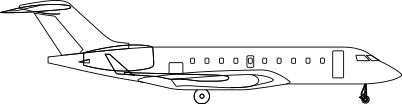
| Specification | Value |
|---|---|
| Manufacturer | Bombardier |
| Category | Super large jet |
| Range* | 5206 km 2811 NM |
| Cruise speed | 850 km/h 459 kts |
| Seats** | 14 |
| Suitcases | 15 |


* with IFR reserves
** in standard configuration
Aircraft Pictures


History
The Challenger 850 is the updated version of the Challenger 800, based on the 50-seat Bombardier CRJ200 LR. It is considered, by any definition, the largest super-large business jet built by Bombardier Aerospace. Produced from 2006 to 2012, the business jet, which has the appearance of a passenger aircraft, has a long private jet with a transcontinental range and an impressive cruising speed of up to 850 km/h. Starting as early as 1996, the aircraft was marketed as the Challenger SE (Special Edition) and then renamed the Challenger 850 in 2006. Production ended in 2012 after 71 deliveries.
This Super Large Jet is based on the same airframe as the CRJ200, but is equipped with interiors for 27, 32 or 50 passengers in commuter configuration or for 14 to 16 passengers in executive configuration.

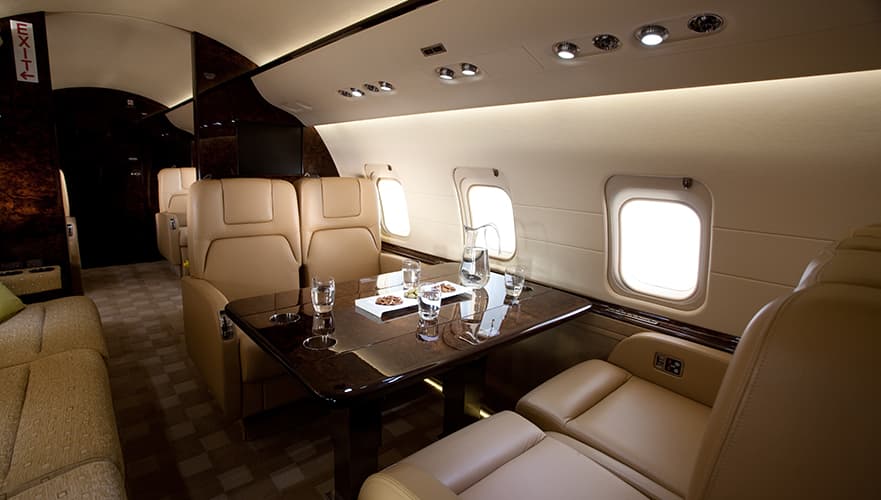
In terms of cabin equipment and comfort, the Challenger 850 is comparable to the much more expensive and somewhat faster Bombardier Global 6000. Its three-zone cabin features a forward and back lavatory, a spacious galley and a baggage compartment accessible from the cabin. The Canadian private aircraft has one of the largest, most productive and comfortable cabins on the market.
Technical Specifications
General information
| Model name | Challenger 850 |
|---|---|
| Manufacturer | Bombardier |
| Aircraft category | super large jet |
| ICAO Designator | CRJ2 |
| Start/End of Production | 2006 - 2012 |
| Number of pilot(s) | 2 |
Performances
| Range (with IFR reserves) | 2811 NM (5206 km) |
|---|---|
| Ferry range | 3096 NM (5734 km) |
| Cruise speed | 459 kts (850 km/h) |
| Max Operating Speed – VMO | 335 KIAS |
| Max Mach Operating Speed - MMO | Mach 0.85 |
| Long-Range Cruise Speed - LRC | 424 KTAS |
| Approach Speed | 141 kts |
| Takeoff Distance | 1922 m |
| Average Landing Distance | 887 m |
| Service Ceiling | 41000 ft |
| Thrust | 8730 lbf |
Aircraft technology
| Engine type | Turbofan |
|---|---|
| Engine(s) | 2 x General Electric CF34-3B1 |
| Avionics | Rockwell Collins Pro Line 4 |
Dimensions and capacity
| Aircraft length | 26.77 m |
|---|---|
| Aircraft height | 6.22 m |
| Wing span | 21.21 m |
| Cabin height | 1.85 m (6.08 ft) |
| Cabin length | 14.76 m (48.42 ft) |
| Cabin width | 2.49 m (8.17 ft) |
| Baggage volume | 5.72 m3 |
| Seats (standard config) | 14 |
| Seats (max) | 16 |
| Suitcases | 15 |
| Carry-on luggage | 12 |
| Maximum payload | 4256 kg |
| Maximum TakeOff Weight - MTOW | 24040 kg |
| Maximum Landing Weight - MLW | 21319 kg |
| Fuel capacity | 10361 L |
Advantages & Disadvantages
Advantages of a Bombardier Challenger 850 as a rental aircraft:
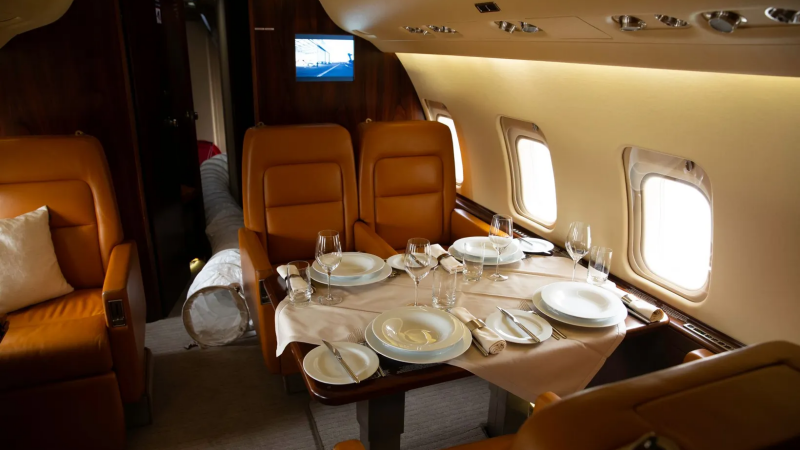
- Exceptionally wide cabin: The wide cabin of the Bombardier Challenger 850 offers spacious seats and plenty of legroom, providing passengers with a comfortable and luxurious flying experience. This extra space also allows for additional amenities such as a fully stocked bar or conference area. This makes the jet ideal for hosting business meetings or entertaining guests during long flights.
- Excellent value: The Challenger 850 has a cabin comparable in size to the Global 6000, but has the running costs and range of a smaller super-midsize jet. Coupled with its comfortable seats and state-of-the-art technology, this makes it a cost-effective option for luxury air travel.
- Resilient: The General Electric turbofan engines used in the Challenger are considered to be extremely low-maintenance. In addition, as a further development of the CRJ200 regional aircraft, the aircraft is designed for up to 12 take-off and landing cycles per day, which are actually only common in scheduled air traffic. The jet thus promises to cope better with demanding operating conditions than the average corporate jet.
- High spare parts availability: As the aircraft is based on the popular CRJ regional jet, a high level of spare parts availability can be assumed. This ensures that all necessary maintenance and repair work can be carried out quickly and efficiently, resulting in greater reliability and smooth operation of the reliable jet.
- Unique cabin comfort: The spacious layout of the large jet offers plenty of room to move, and the two separate lavatory areas underscore the exceptional cabin comfort. The walk-in baggage compartment makes it easy to stow and retrieve luggage, even during flight. The galley lacks a high-tech design, but is neither less functional nor less luxurious because of it, offering everything you could want during a long flight.
Disadvantages of a Bombardier Challenger 850 as a rental aircraft:
- No longer in production: The Challenger 850 is not in the Canadian aircraft manufacturer's current programme. This could be a disadvantage for those who want to charter a cutting-edge aircraft with the very latest features. The Challenger 850 is therefore probably not the first choice if they want to impress business partners and present themselves as a modern and innovative player in the business world.
- Requires a long runway: Compared to classic business jets, the 850 has a larger space requirement for take-off and landing, especially in hot temperatures. This aircraft is therefore certainly not the best choice for flights to or from Aspen in mid-summer. In practice, 850 jets operate at frequently busy commercial airports, which could increase travel time.
Possible alternatives to a Challenger 850 as a business charter aircraft are the Falcon 2000EX, the Embraer Legacy 650 and the Bombardier Global 6000. The Falcon 2000EX offers a comparably spacious cabin and efficient fuel consumption, while the Embraer Legacy 650 comes with a fully equipped executive interior. The Bombardier Global 6000 scores high on range, allowing it to reach far-flung destinations without stopping for fuel. Each of these private jets offers luxurious amenities and reliable performance for demanding business travel.
If you're looking for a luxurious and comfortable aircraft that offers excellent value for money, the Bombardier Challenger 850 should be at the top of your list. With its spacious cabin and a host of amenities, this jet is perfect for business meetings or long flights with business partners, friends or family.
Where the Bombardier Challenger 850 flies most
The Bombardier Challenger 850 is a business version of a regional airliner, and its charter map reflects that size. London leads with 1,527 movements, ahead of Istanbul (1,109) and Nice (775).
Much of Istanbul's traffic comes from its links with Russia. Istanbul to Moscow was the type's busiest route, with 249 flights. Dubai (110 flights), Bodrum and Antalya were also connected to Moscow. Moscow itself is outside the scope of this ranking.
In Western Europe, the Challenger 850 flies classic routes such as London to Nice (149 flights) and London to Paris (116). In Ibiza, 68% of the type's movements fell between June and September. Dubai is a winter destination for the type, with 47% of its movements between December and March. Half of the flights in the region covered more than 1,000 km.
Based on LunaJets analysis of ADS-B flight tracking data. Contains information from adsb.lol, made available under the Open Database License (ODbL). The figures cover take-offs and landings on commercial charter flights (Part 135 / CAT) in 2025, in Europe, the Middle East and North Africa. They include every version that shares the aircraft's type code, and a city needs at least 20 movements to be ranked.
Top Cities in 2025
The Challenger 850 suits larger groups. The pages on Istanbul and private flights to Ibiza cover prices and airport choices for a summer or business trip.
FAQ
How much does a Bombardier Challenger 850 business jet cost?
A used Bombardier Challenger 850 business jet currently costs between $7.5 million and $10.5 million. Factors such as the age of the aircraft, engine hours and additional equipment or upgrades can affect the exact price. Since the jet is no longer in production, no new examples are available. When it was still available, a new Challenger 850 cost around $32 million.
How many Bombardier Challenger 850 aircraft have been sold so far?
A total of 71 Bombardier Challenger 850s were sold. This figure reflects total deliveries from the start of production in 2006 until 2012. The Challenger 850 is popular with business and VIP customers primarily because of its spacious taxiin and long-haul capability. Compared to other models in the Bombardier Challenger range, this is a relatively small number. The smaller and less expensive Challenger 350 and Challenger 650 models were sold much more frequently.
How does the Bombardier Challenger 850 differ from the Gulfstream G650?
The Bombardier Challenger 850 offers a larger taxiin as standard and often has a lower charter price - also due to its generally higher age. However, the Embraer Legacy 650 also offers excellent value for money: it has greater range and slightly better runway performance. Both aircraft are among the best in their class.
How many seats does a Challenger 850 have?
The Challenger 850 has a total of 14 seats. In its maximum configuration, there is room for 16 people. However, a configuration with a maximum of 14 or 15 passenger seats is much more common and comfortable. The extra-wide taxiin design ensures comfortable spacing between seats and allows sufficient freedom of movement for a relaxing flight.
How far can a Bombardier Challenger 850 fly?
The maximum distance a Challenger 850 can cover is 5,206 kilometres: An excellent range for a super large jet with high passenger capacity and exceptional comfort. It can fly between New York and Los Angeles (approx. 3,936 km) and from Rome to Moscow (approx. 4,753 km) without a stopover.
Can the Challenger 850 access smaller airports?
Due to its size and airliner heritage, the Challenger 850 requires longer runways than smaller jets. It is well-suited to major business airports such as London Luton or Paris Le Bourget, but less adapted for short or steep-approach runways like London City. Clients should plan itineraries with established regional or international airports.
How does the Challenger 850 compare to the Bombardier Global Express?
Both share similar cabin dimensions, but the Global Express is designed for ultra-long-range travel. It offers an NBAA IFR range of 11,038 km (5,960 nm), far beyond the Challenger 850’s 5,206 km (2,811 nm). The Challenger 850 delivers the same large-cabin experience at lower charter costs, but it is limited to shorter ranges. Clients usually choose between them based on whether distance or budget is the main priority.
What is the flight range of the Challenger 850?
The Challenger 850 has an NBAA IFR range of 5,206 km (2,811 nm). It can link city pairs such as London–Cairo or New York–Seattle.
How does the Challenger 850 compare to the Embraer Legacy 600?
The Challenger 850 and Legacy 600 sit in the same segment: large-cabin jets designed for regional to medium-haul flights. The Challenger 850 seats 14 passengers (standard configuration), while the Legacy 600 seats 8 passengers but flies farther, with an NBAA IFR range of 6,019 km (3,250 nm) compared to the Challenger’s 5,206 km (2,811 nm). Both are chosen for group or corporate travel where cabin space matters as much as range.