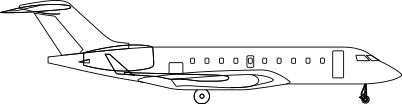
Bombardier Global 5000
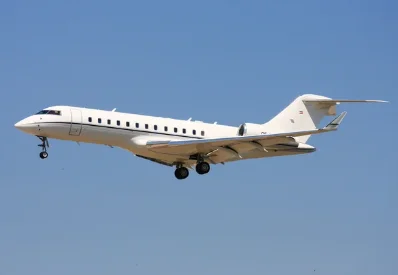
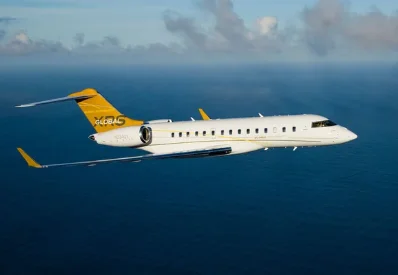
Launched in 2005, the Global 5000 benefits from all the latest technology both in the cockpit and in the cabin. For example, it features weather detection and noise-reduction systems to avoid turbulence and provide an extremely quiet cabin. This aircraft provides the perfect combination of space, comfort and speed while maintaining intercontinental capabilities. Due to its outstanding take-off and landing performance, smaller airfields remain accessible to the Global 5000, which is extremely impressive considering it can carry up to 13 passengers. Bombardier even claims that this aircraft can make transatlantic flights, such as Paris to Washington, a whole hour faster than its competitors. All things considered, the Global 5000 represents a luxurious solution for both your short-haul and long-haul travel needs.
Super Large Jet
| Specification | Value |
|---|---|
| Manufacturer | Bombardier |
| Category | Super Large Jet |
| Range* | 9630 km 5200 NM |
| Cruise speed | 946 km/h 511 kts |
| Seats** | 13 |
| Suitcases | 16 |


* with IFR reserves
** in standard configuration
Aircraft Pictures


History
Technical Specifications
General information
| Model name | Global 5000 |
|---|---|
| Manufacturer | Bombardier |
| Aircraft category | super large jet |
| ICAO Designator | GL5T |
| Start/End of Production | 2005 - 2018 |
| Number of pilot(s) | 2 |
Performances
| Range (with IFR reserves) | 5200 NM (9630 km) |
|---|---|
| Ferry range | 5475 NM (10140 km) |
| Cruise speed | 511 kts (946 km/h) |
| Max Operating Speed – VMO | 340 KIAS |
| Max Mach Operating Speed - MMO | Mach 0.89 |
| Long-Range Cruise Speed - LRC | 488 KTAS |
| Approach Speed | 107 kts |
| Takeoff Distance | 1690 m |
| Average Landing Distance | 670 m |
| Rate of Climb | 3450 ft/min |
| Service Ceiling | 51000 ft |
| Thrust | 14750 lbf |
Aircraft technology
| Engine type | Turbofan |
|---|---|
| Engine(s) | 2 |
| Avionics | Honeywell Primus 2000XP |
Dimensions and capacity
| Aircraft length | 29.5 m |
|---|---|
| Aircraft height | 7.8 m |
| Wing span | 28.7 m |
| Cabin height | 1.91 m (6.25 ft) |
| Cabin length | 12.95 m (42.47 ft) |
| Cabin width | 2.49 m (8.17 ft) |
| Baggage volume | 5.5 m3 |
| Seats (standard config) | 13 |
| Seats (max) | 19 |
| Suitcases | 16 |
| Carry-on luggage | 14 |
| Maximum payload | 3250 kg |
| Maximum TakeOff Weight - MTOW | 42000 kg |
| Maximum Landing Weight - MLW | 35700 kg |
| Fuel capacity | 22200 L |
FAQ
Can the Global 5000 operate into smaller airports?
The Bombardier Global 5000 is certified for steep approaches, which permits operations into demanding airports such as London City, where short runways and steep descent paths are required. Its typical take-off distance is about 1,500 m and landing distance around 800 m, depending on weight and conditions. This performance allows access to airports like Sion, though very short fields such as Gstaad (Saanen) remain beyond its limits.
How does the Bombardier Global 5000 compare to the Dassault Falcon 7X?
Both the Bombardier Global 5000 and the Dassault Falcon 7X are long-range, large-cabin jets. The Global 5000 seats 13 passengers (standard configuration), while the Falcon 7X seats 14 passengers. In range, the Global 5000 flies up to 9,630 km (5,200 nm) NBAA IFR, while the Falcon 7X reaches about 11,019 km (5,950 nm) NBAA IFR. The Falcon 7X can also use airports with shorter runways such as Gstaad (Saanen), which the Global 5000 cannot.
How does the Bombardier Global 5000 compare to the Global 6000, Global 7500, and Global 8000?
The Global 5000 was succeeded by the Global 6000, which extended range to about 11,112 km (6,000 nm) NBAA IFR and introduced newer avionics and interior refinements. The Global 7500 (originally announced as the Global 7000) is a larger aircraft with four cabin zones and an ultra-long-range of 13,334 km (7,700 nm) NBAA IFR, allowing nonstop flights such as New York to Hong Kong. Bombardier also launched the Global 8000, offering similar cabin dimensions to the 7500 but with a longer range of around 14,816 km (8,000 nm). In charter, the Global 5000 remains a practical choice for intercontinental travel, while its successors target missions that require extended range and larger cabin layouts.
What is the maximum range of the Global 5000?
The Global 5000 has an NBAA IFR range of 9,630 km (5,200 nm). This allows nonstop city pairs such as Munich to New York or London to Delhi. It provides long-haul capability without needing fuel stops on most intercontinental routes.