Dassault Falcon 900B
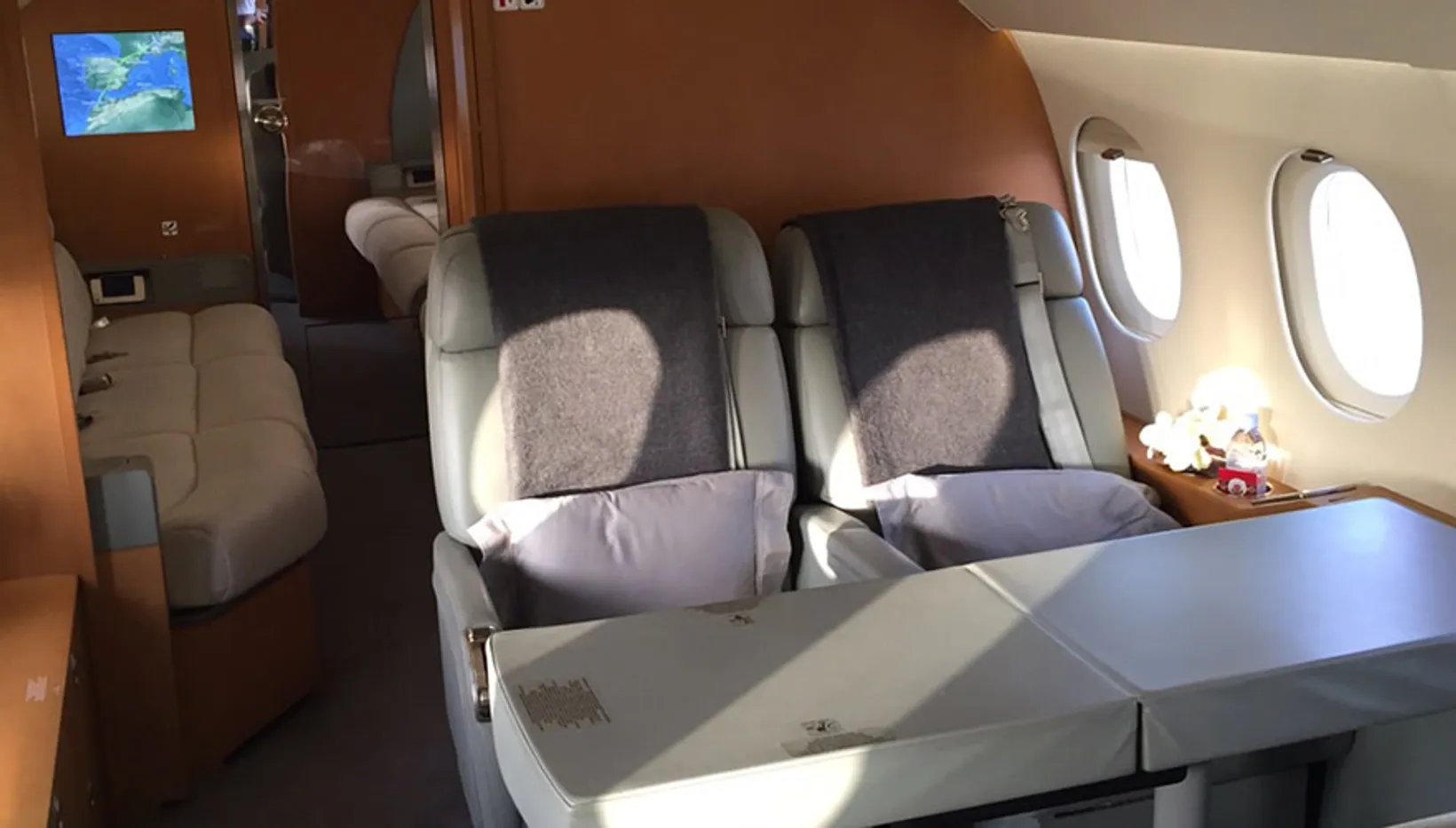
The Falcon 900B was first certified in 1992 as an upgrade to the Falcon 900 and belonged to the same category of Super Large Jets as its predecessor. Produced by French manufacturer Dassault, the 900B is also a tri-jet but is equipped with much-upgraded engines to the original Falcon 900, enabling it to produce more power and operate with greater efficiency, serving to largely increase its range. Like the 900, the 900B features a large stand-up cabin that typically seats between 10 and 12 passengers in a comfortable executive seating configuration but can accommodate up to 14. The Falcon 900B is the first variant of the Falcon 900, which was repeatedly upgraded to create a whole range of Dassault aircraft that have excelled for over 30 years among other intercontinental business jets.
Super large jet
| Specification | Value |
|---|---|
| Manufacturer | Dassault |
| Category | Super large jet |
| Range* | 7408 km 4000 NM |
| Cruise speed | 878 km/h 474 kts |
| Seats** | 12 |
| Suitcases | 12 |


* with IFR reserves
** in standard configuration
Aircraft Pictures

History
The Falcon 900B emerged as the first major upgrade to Dassault's successful Falcon 900 design, entering production in 1991. The 900B addressed operator feedback by incorporating more powerful and fuel-efficient engines.
Production ran from 1991 to 2000, providing operators with enhanced performance compared to the original 900. The aircraft featured improved engines that delivered increased thrust and better fuel economy for extended range operations.
The 900B maintained the proven trijet configuration while offering increased range capabilities that expanded operational flexibility. The aircraft served airports and missions that were challenging for twin-engine competitors, thanks to its three-engine redundancy.
Combined with the original Falcon 900, 160 aircraft were delivered across both variants. The 900B's improvements established the template for future Falcon 900 developments, demonstrating Dassault's commitment to continuous enhancement of proven designs.
Technical Specifications
General information
| Model name | Falcon 900B |
|---|---|
| Manufacturer | Dassault Aviation |
| Aircraft category | super large jet |
| ICAO Designator | F900 |
| Start/End of Production | 1991 - 2000 |
| Number of pilot(s) | 2 |
Performances
| Range (with IFR reserves) | 4000 NM (7408 km) |
|---|---|
| Ferry range | 4600 NM (8519 km) |
| Cruise speed | 474 kts (878 km/h) |
| Max Operating Speed – VMO | 370 KIAS |
| Max Mach Operating Speed - MMO | Mach 0.87 |
| Long-Range Cruise Speed - LRC | 426 KTAS |
| Approach Speed | 85 kts |
| Takeoff Distance | 1585 m |
| Average Landing Distance | 671 m |
| Service Ceiling | 51000 ft |
| Thrust | 4750 lbf |
Aircraft technology
| Engine type | Turbofan |
|---|---|
| Engine(s) | 3 x Honeywell TFE731-5BR |
| Avionics | Honeywell Primus Epic |
Dimensions and capacity
| Aircraft length | 20.21 m |
|---|---|
| Aircraft height | 7.55 m |
| Wing span | 19.33 m |
| Cabin height | 1.9 m (6.2 ft) |
| Cabin length | 10.11 m (33.17 ft) |
| Cabin width | 2.3 m (7.7 ft) |
| Baggage volume | 3.6 m3 |
| Seats (standard config) | 12 |
| Seats (max) | 19 |
| Suitcases | 12 |
| Carry-on luggage | 10 |
| Maximum TakeOff Weight - MTOW | 20640 kg |
| Maximum Landing Weight - MLW | 19050 kg |
| Fuel capacity | 10862 L |
FAQ
Why is the Falcon 900B's trijet configuration better than other aircraft with only 2 engines?
The Falcon 900B's three-engine design provides superior safety redundancy compared to twin-engine aircraft. In the event of an engine failure, the aircraft retains two functioning engines rather than just one, ensuring better climb performance and operational capability. Additionally, the trijet configuration allows access to airports with more restrictive regulations for twin-engine operations, particularly those with challenging terrain or weather conditions where extended twin-engine operations (ETOPS) limitations might apply.
What are the key differences between the Falcon 900B, 900C, and 900DX models?
The Falcon 900B (878 km/h cruise speed) is slightly slower than both the 900C (885 km/h) and 900DX (893 km/h). All three models share the same range of 7,408 km, but the 900C introduced more advanced avionics from the 900EX, whilst the 900DX featured the Honeywell Primus Epic EASy digital cockpit system. The 900B was produced from 1991-2000, the 900C from 2000-2005, and the 900DX from 2005-2010.
How many passengers can the Falcon 900B accommodate?
The Falcon 900B can seat between 8 and 12 passengers in its standard executive configuration, with a maximum capacity of up to 19 passengers in high-density seating. The cabin measures 10.06 metres in length, 2.34 metres in width, and 1.88 metres in height, providing a spacious stand-up cabin environment.
What is the cruising speed of the Falcon 900B?
The Falcon 900B cruises at 878 km/h (474 knots). This performance allows the aircraft to complete the Paris to Munich route in approximately 1 hour and 15 minutes, making it well-suited for European business routes where time efficiency is crucial.
What is the maximum range of the Falcon 900B, and which city pairs can it connect?
The Falcon 900B offers a maximum range of 7,408 km (4,000 nautical miles). This capability enables the aircraft to connect city pairs such as London to Miami, which requires approximately 7,100 km, providing a comfortable margin for adverse weather conditions or routing requirements. This range makes it suitable for transatlantic business travel without requiring fuel stops.