
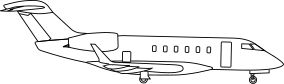
Bombardier Challenger 350
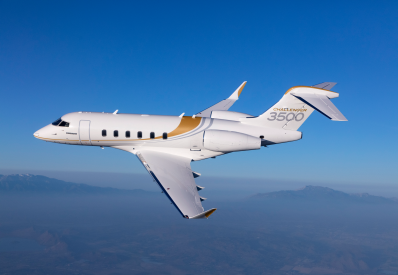
Launched in mid-2014, the Challenger 350 is the sister aircraft of the best-selling Super Midsize Jet of all time, the Challenger 300, and belongs to the same category. It features the same impressive stand-up cabin as its predecessor, considerably larger than that of a number of its rivals, the Falcon 50 and the Citation X, for example. The 350 is equipped with updated avionics and weather detection systems, which reduce pilot workload, increase reliability, and greatly improve the jet's capacity to avoid turbulence, increasing passenger comfort. Furthermore, the Challenger 350 provides a greater range than the 300, thanks to the performance-enhancing engine upgrades it has received. Overall, Bombardier has improved on an already accomplished aircraft to create the Challenger 350, resulting in a state-of-the-art business jet, capable of providing an excellent service.
Super Midsize Jet
| Specification | Value |
|---|---|
| Manufacturer | Bombardier |
| Category | Super Midsize Jet |
| Range* | 5926 km 3200 NM |
| Cruise speed | 978 km/h 528 kts |
| Seats** | 8 |
| Suitcases | 8 |


* with IFR reserves
** in standard configuration
Aircraft Pictures


History
Bombardier announced the Challenger 350 on May 20, 2013, at EBACE as an enhanced version of the successful Challenger 300. The first aircraft flew on March 2, 2013, ahead of the official launch.
The 350 featured significant upgrades over its predecessor, including more powerful Honeywell HTF7350 engines producing 7,323 pounds of thrust - a 7.3% increase over the 300's powerplants. The aircraft also incorporated new canted winglets and strengthened wings for improved performance.
Avionics received a major upgrade with the Pro Line 21 Advanced system, featuring synthetic vision, dual inertial reference systems, and MultiScan weather radar. The cockpit became fully paperless, reducing pilot workload while increasing situational awareness.
Transport Canada granted certification on June 12, 2014, followed by FAA approval on June 25. The 350 offered 145 nautical miles more range than the 300, reaching 3,200 nautical miles with eight passengers. Priced at $25.9 million at launch, the aircraft continued Bombardier's success in the super mid-size category with enhanced performance and modern systems.
Technical Specifications
General information
| Model name | Challenger 350 |
|---|---|
| Manufacturer | Bombardier |
| Aircraft category | super midsize jet |
| ICAO Designator | CL35 |
| Start/End of Production | 2014 - Still in production |
| Number of pilot(s) | 2 |
Performances
| Range (with IFR reserves) | 3200 NM (5926 km) |
|---|---|
| Ferry range | 3400 NM (6297 km) |
| Cruise speed | 528 kts (978 km/h) |
| Max Operating Speed – VMO | 320 KIAS |
| Max Mach Operating Speed - MMO | Mach 0.83 |
| Long-Range Cruise Speed - LRC | 459 KTAS |
| Approach Speed | 115 kts |
| Takeoff Distance | 1470 m |
| Average Landing Distance | 720 m |
| Rate of Climb | 4000 ft/min |
| Service Ceiling | 45000 ft |
| Thrust | 7323 lbf |
Aircraft technology
| Engine type | Turbofan |
|---|---|
| Engine(s) | 2 |
| Avionics | Collins Aerospace Advanced Avionics |
Dimensions and capacity
| Aircraft length | 20.9 m |
|---|---|
| Aircraft height | 6.1 m |
| Wing span | 21 m |
| Cabin height | 1.85 m (6.10 ft) |
| Cabin length | 7.68 m (25.20 ft) |
| Cabin width | 2.18 m (7.20 ft) |
| Baggage volume | 3 m3 |
| Seats (standard config) | 8 |
| Seats (max) | 10 |
| Suitcases | 8 |
| Carry-on luggage | 8 |
| Maximum payload | 1550 kg |
| Maximum TakeOff Weight - MTOW | 18400 kg |
| Maximum Landing Weight - MLW | 15500 kg |
| Fuel capacity | 8000 L |
FAQ
How far can the Challenger 350 fly without refuelling?
The Challenger 350 has an NBAA IFR range of 5,926 km (3,200 nm), allowing nonstop connections between major city pairs such as New York and London or Paris and Dubai under favourable conditions. This performance makes it suitable for both transcontinental and long regional routes.
What is the difference between the Challenger 350 and the Challenger 3500?
The Challenger 3500, introduced in 2021, is the updated version of the Challenger 350. Both share the same range of about 5,926 km (3,200 nm) and seat 8 passengers (standard configuration). The main improvements in the 3500 are inside the cabin: redesigned seats with advanced ergonomics, a lower cabin altitude (4,850 ft at cruise vs 7,250 ft in the 350), and the introduction of voice-controlled cabin systems. The 3500 also comes with more modern avionics and interior options, while keeping the proven performance of the 350.
Can the Challenger 350 operate from smaller airports such as London City or Gstaad?
The Challenger 350 can access some smaller airports but not all. It is certified for steep approaches at London City Airport (LCY), meeting the requirements of the 5.5-degree approach and shorter runway. However, Gstaad’s Saanen Airport (LSGK) is limited to smaller turboprops and light aircraft because of its short runway and surrounding terrain, which makes it unsuitable for the Challenger 350.
What is the difference between the Challenger 350 and the Challenger 650?
The Challenger 350 is a super mid-size jet, seating 8 passengers (standard configuration), with an NBAA IFR range of 5,926 km (3,200 nm). It is valued for short-field performance and efficiency on regional and transcontinental routes. The Challenger 650, by contrast, is a large-cabin jet that seats 10 passengers (standard configuration) and can fly up to 7,408 km (4,000 nm). It offers a wider cabin, more seating layout options, and intercontinental reach. In short: the 350 suits mid-size groups on medium to long routes, while the 650 is designed for larger groups and nonstop transoceanic flights.