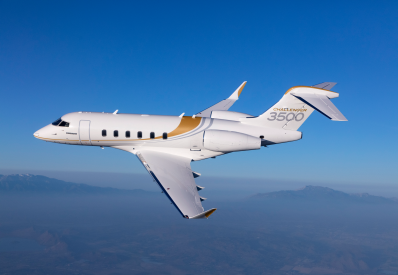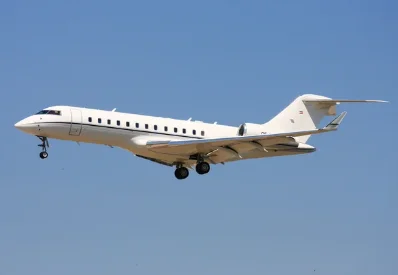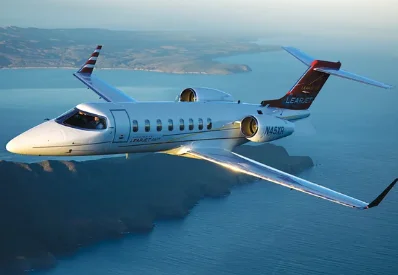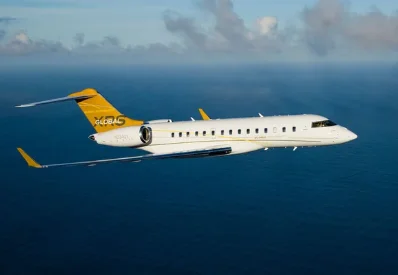
Bombardier Challenger 300
Formerly known as the 'Continental', Bombardier launched the smallest of their Challenger series, the Challenger 300, in 2003 with one objective: to provide the cabin size and space of a Large Jet for the price of a Super Midsize Jet. The Challenger 300 features a very spacious stand-up cabin, larger than that of many of its competitors in the same category of Super Midsize Jets, and is excellent value for money. The typical layout is a Club 4 arrangement, three-seater sofa and two individual seats, allowing up to 9 passengers to travel in optimum comfort. In addition to this comfortable interior, the 300 also provides an excellent service due to its high-performance capacity. It offers a competitive range of over 5,700 km, making it capable of connecting Cannes and Dubai, for example. Extremely spacious and reliable, the Challenger 300 comes highly recommended for medium-haul flights.
Super midsize jet
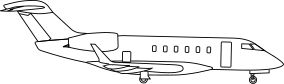
| Specification | Value |
|---|---|
| Manufacturer | Bombardier |
| Category | Super midsize jet |
| Range* | 5741 km 3100 NM |
| Cruise speed | 870 km/h 470 kts |
| Seats** | 8 |
| Suitcases | 8 |


* with IFR reserves
** in standard configuration
Aircraft Pictures


History
Bombardier launched the Continental project at the 1999 Paris Air Show, later renamed the Challenger 300. The aircraft represented a clean-sheet design intended to bridge the gap between the Learjet 60 and Challenger 604 in the super mid-size category.
Development began in the late 1990s, with key suppliers including Rockwell Collins for the Pro Line 21 avionics and AlliedSignal for the AS907 turbofan engines. The first prototype made its maiden flight on August 14, 2001, from Bombardier's Wichita facility.
The certification process took longer than expected due to engine delays. Transport Canada granted approval on May 31, 2003, followed by FAA certification on June 4 and European JAR 25 approval on July 31. The aircraft entered service on January 8, 2004, with Flexjet as the launch customer.
At launch, the Challenger 300 was priced at $17.4 million, undercutting competitors while offering superior range and cabin comfort. The aircraft's success established Bombardier's position in the super mid-size market, with the 300 becoming one of the most popular business jets in its class and serving as the foundation for the later Challenger 350 variant.
Technical Specifications
General information
| Model name | Challenger 300 |
|---|---|
| Manufacturer | Bombardier |
| Aircraft category | super midsize jet |
| ICAO Designator | CL30 |
| Start/End of Production | 2003 - 2014 |
| Number of pilot(s) | 2 |
Performances
| Range (with IFR reserves) | 3100 NM (5741 km) |
|---|---|
| Ferry range | 3300 NM (6112 km) |
| Cruise speed | 470 kts (870 km/h) |
| Max Operating Speed – VMO | 320 KIAS |
| Max Mach Operating Speed - MMO | Mach 0.83 |
| Long-Range Cruise Speed - LRC | 459 KTAS |
| Approach Speed | 115 kts |
| Takeoff Distance | 1470 m |
| Average Landing Distance | 790 m |
| Rate of Climb | 5000 ft/min |
| Service Ceiling | 45000 ft |
| Thrust | 6826 lbf |
Aircraft technology
| Engine type | Turbofan |
|---|---|
| Engine(s) | 2 |
| Avionics | Rockwell Collins ProLine 21 |
Dimensions and capacity
| Aircraft length | 20.92 m |
|---|---|
| Aircraft height | 6.2 m |
| Wing span | 19.46 m |
| Cabin height | 1.86 m (6.10 ft) |
| Cabin length | 7.68 m (25.20 ft) |
| Cabin width | 2.19 m (7.20 ft) |
| Baggage volume | 3 m3 |
| Seats (standard config) | 8 |
| Seats (max) | 10 |
| Suitcases | 8 |
| Carry-on luggage | 8 |
| Maximum payload | 1600 kg |
| Maximum TakeOff Weight - MTOW | 17600 kg |
| Maximum Landing Weight - MLW | 15300 kg |
| Fuel capacity | 8000 L |
Where the Bombardier Challenger 300 flies most
Only 11% of the Bombardier Challenger 300's commercial charter flights in 2025 started or ended in Europe, the Middle East or North Africa. Most of its charter flying takes place in the United States.
London leads with 752 movements, about twice as many as Istanbul (355) and Nice (338). London's figures lean strongly towards summer: 62% of its movements took place between June and September, with Nice, Milan and Paris as the most frequent partners.
The rest of the list is a summer map of Europe. Ibiza (69%), Malaga (68%), Nice (59%) and Palma de Mallorca (58%) recorded most of their movements between June and September. Half of the flights in the region covered less than 930 km.
Based on LunaJets analysis of ADS-B flight tracking data. Contains information from adsb.lol, made available under the Open Database License (ODbL). The figures cover take-offs and landings on commercial charter flights (Part 135 / CAT) in 2025, in Europe, the Middle East and North Africa. They include every version that shares the aircraft's type code, and a city needs at least 20 movements to be ranked.
Top Cities in 2025
The Challenger 300 is mostly a summer aircraft in Europe. The pages on Ibiza and flights to Malaga cover charter prices, airports and where to stay.
FAQ
How does the Challenger 300 compare to the Challenger 600?
The Challenger 300 is a super-midsize jet, designed for groups of 8 passengers (standard configuration), with an NBAA IFR range of 5,741 km (3,100 nm). It combines strong runway performance with lower operating costs, making it ideal for city-to-city business travel. The Challenger 600 series, introduced earlier, is a wide-cabin heavy jet that can typically seat 9 passengers and fly farther — with the Challenger 604 and 605 reaching 6,956 km (3,756 nm), and the Challenger 650 extending to 7,408 km (4,000 nm). For clients, the choice often depends on whether they need the cost-efficiency and airport flexibility of the 300 or the intercontinental reach of the 600.
How far can the Challenger 300 fly without refuelling?
The Bombardier Challenger 300 offers an NBAA IFR range of 5,741 km (3,100 nm). This allows it to fly popular transcontinental routes such as London to New York or Dubai to Geneva without a fuel stop. Actual range depends on passenger load, baggage, and weather conditions, but its performance firmly places it among the most capable aircraft in the super-midsize category.
What is the cabin experience like on the Challenger 300?
The Challenger 300 features a spacious, flat-floor cabin with stand-up height, allowing passengers to move comfortably throughout the flight. Large windows at every seat provide natural light, while the interior is typically arranged for 8 passengers. A private lavatory and a well-equipped galley ensure convenience on longer journeys, giving the aircraft the feel of a larger jet while retaining the efficiency of a super-midsize model.
When was the Challenger 300 introduced, and is it still available?
Bombardier certified the Challenger 300 in 2003, and it entered service the following year. Production continued until 2014, when the upgraded Challenger 350 was launched as its successor. While the Challenger 300 is no longer in production, it remains widely available on the charter market.