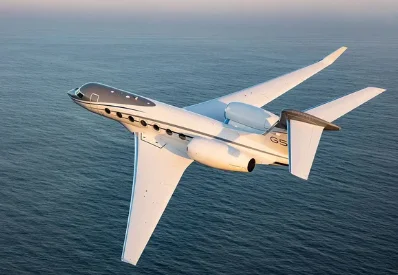
Gulfstream GIV
Gulfstream launched the GIV in 1985 as a much-upgraded and larger version of the GIII. The GIV’s intelligent design, stylish exterior and powerful engines help to explain the aircraft’s popularity and why its production lasted nearly 20 years, during which time it succeeded in setting over 50 world records for round-the-world flights. The GIV’s impressive range, reliability and overall performance, along with its large stand-up cabin mean that, unlike its predecessors, it is categorised as a Super Large Jet. The spacious interior typically accommodates 14 passengers in optimum comfort but, in certain configurations, the GIV can seat up to 19. Gulfstream’s most recent aircraft, including the G450, G550 and G650, are all modelled from the original GIV, a true testament to an aircraft that set the standard in its class for so many years.
Super Large Jet
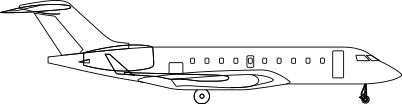
| Specification | Value |
|---|---|
| Manufacturer | Gulfstream |
| Category | Super Large Jet |
| Range* | 7577 km 4091 NM |
| Cruise speed | 889 km/h 480 kts |
| Seats** | 14 |
| Suitcases | 19 |


* with IFR reserves
** in standard configuration
Aircraft Pictures


History
Gulfstream, in collaboration with Grumman, began development of the Gulfstream IV in March 1983 as a re-engined, stretched fuselage derivative of the Gulfstream III.
The GIV made its maiden flight on September 19, 1985, beginning an extensive test programme. The aircraft received FAA type certification on April 22, 1987, validating its advanced systems and performance capabilities.
The G-IV entered service with serial number 1000 in 1987, establishing new standards in business aviation. The aircraft featured increased range, larger cabin, and more advanced avionics compared to its predecessor.
The GIV was upgraded to the GIV-SP version at serial number 1214 in 1992, incorporating operational improvements and enhanced performance. The aircraft family became one of the most successful in business aviation history, establishing Gulfstream's reputation for long-range capability and luxury.
Technical Specifications
General information
| Model name | GIV |
|---|---|
| Manufacturer | Gulfstream |
| Aircraft category | super large jet |
| ICAO Designator | GLF4 |
| Start/End of Production | 1986 - 1992 |
| Number of pilot(s) | 2 |
Performances
| Range (with IFR reserves) | 4091 NM (7577 km) |
|---|---|
| Ferry range | 4220 NM (7815 km) |
| Cruise speed | 480 kts (889 km/h) |
| Max Operating Speed – VMO | 340 KIAS |
| Max Mach Operating Speed - MMO | Mach 0.88 |
| Long-Range Cruise Speed - LRC | 459 KTAS |
| Approach Speed | 130 kts |
| Takeoff Distance | 1722 m |
| Average Landing Distance | 911 m |
| Rate of Climb | 4000 ft/min |
| Service Ceiling | 45000 ft |
| Thrust | 13850 lbf |
Aircraft technology
| Engine type | Turbofan |
|---|---|
| Engine(s) | 2 x Rolls-Royce TAY 611-8 |
| Avionics | Honeywell SPZ-8000 |
Dimensions and capacity
| Aircraft length | 26.91 m |
|---|---|
| Aircraft height | 7.44 m |
| Wing span | 23.72 m |
| Cabin height | 1.89 m (6.08 ft) |
| Cabin length | 13.75 m (45.08 ft) |
| Cabin width | 2.23 m (7.25 ft) |
| Baggage volume | 4.79 m3 |
| Seats (standard config) | 14 |
| Seats (max) | 19 |
| Suitcases | 19 |
| Carry-on luggage | 15 |
| Maximum payload | 1542 kg |
| Maximum TakeOff Weight - MTOW | 33203 kg |
| Maximum Landing Weight - MLW | 26535 kg |
FAQ
What is the operational range of the GIV and which intercontinental routes can it complete non-stop?
The Gulfstream GIV offers an NBAA IFR range of 7,593 kilometres (4,100 nautical miles), providing substantial intercontinental capabilities. This range enables the aircraft to complete demanding routes such as London to Los Angeles or Frankfurt to Tokyo non-stop with appropriate passenger and baggage loads. The GIV's range performance made it a pioneering aircraft in its era, establishing Gulfstream's reputation for long-range business aviation and setting the foundation for future developments in the super large jet category.
How many passengers can the GIV accommodate and what cabin features contribute to passenger comfort?
The Gulfstream GIV typically seats 14 passengers in its standard executive configuration, with the flexibility to accommodate up to 19 passengers in high-density layouts. The aircraft features a spacious stand-up cabin measuring 13.74 metres in length, 2.22 metres in width, and 1.87 metres in height, providing generous interior space that distinguishes it from smaller business jets. This cabin size allows for multiple seating areas and work zones, enabling passengers to conduct business meetings, relax, or sleep comfortably during long-haul flights.
What is the cruise speed of the Gulfstream GIV and how does this performance benefit transcontinental travel?
The Gulfstream GIV achieves a cruise speed of 889 km/h (480 knots), positioning it competitively within the super large jet category. This speed proves particularly advantageous for transcontinental journeys, allowing passengers to complete routes such as London to Dubai or New York to Rome efficiently. The GIV's cruising speed, combined with its robust climb performance and high-altitude capabilities, enables it to maintain schedule reliability whilst navigating busy airspace corridors typical of transcontinental routes.
Is the GIV faster than its predecessor, the G-III, and how do their operational capabilities compare?
The Gulfstream GIV offers slightly slower cruise speed than the G-III at 889 km/h compared to the G-III's 904 km/h (488 knots), but this marginal difference is overshadowed by significant improvements in other areas. The GIV provides substantially greater range at 7,593 kilometres versus the G-III's 6,760 kilometres, whilst accommodating one additional passenger in standard configuration (14 versus 12). The GIV also features a longer cabin at 13.74 metres compared to the G-III's 12.57 metres, enhanced systems reliability, and improved engines that deliver better fuel efficiency and reduced operating costs.
What made the GIV historically significant in business aviation and why did production cease in 1992?
The Gulfstream GIV achieved remarkable historical significance by setting over 50 world records for round-the-world flights during its production run from 1986 to 1992, establishing new benchmarks for business aviation performance and reliability. The aircraft pioneered the super large jet category and became the foundation for Gulfstream's most advanced models, including the G450, G550, and G650. Production ceased in 1992 as Gulfstream introduced the enhanced GIV-SP variant, which incorporated operational improvements and performance upgrades whilst maintaining the proven design philosophy that made the original GIV exceptionally successful.