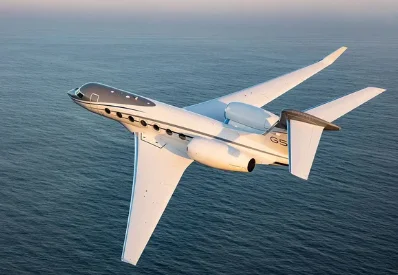
Gulfstream G350
The G350 entered into service in late 2004 as a replacement for the GIII and is categorised as a Large Business Jet. This aircraft is Gulfstream's response to clients looking for the interior and luggage space of a Super Large Jet but without the need for real long-range capability. The G350 therefore has the same floor space as the G450 but, due to it not matching the G450's range, it is available at a lower cost.
With the capacity to fly uninterrupted for over 7000km, the G350 is still able to carry out intercontinental flights and is also extremely fast, more so than both the Challenger 605 and the Legacy 600. The signature Gulfstream windows light up the spacious cabin, which is fitted with seating for up to 14 passengers as well as a full galley. The G350 also features a low pressurisation zone to reduce journey fatigue and ensure that passengers arrive at their destination feeling refreshed. Fast, spacious and comfortable; the G350 is an excellent solution to your medium-haul flight requirements.
Large jet
| Specification | Value |
|---|---|
| Manufacturer | Gulfstream Aerospace |
| Category | Large jet |
| Range* | 7038 km 3800 NM |
| Cruise speed | 882 km/h 476 kts |
| Seats** | 14 |
| Suitcases | 12 |


* with IFR reserves
** in standard configuration
Aircraft Pictures

History
The Gulfstream G350 was developed as a shorter-range version of the G450, receiving certification in 2004. The aircraft was designed to provide large-cabin comfort with mid-range performance characteristics.
The G350 received both Type Certificate and Production Certificate from the FAA in November 2004, followed by EASA validation on March 30, 2005. This comprehensive certification process validated the aircraft's systems and performance capabilities.
The first G350 entered service in June 2005, offering customers Gulfstream's renowned build quality and support network. The aircraft featured a spacious cabin while providing operational economics suited for medium-range missions.
The G350 filled an important role in Gulfstream's lineup, offering operators who didn't require maximum range the ability to access large-cabin comfort at reduced operating costs. The aircraft demonstrated Gulfstream's understanding of diverse customer requirements within the business aviation market.
Technical Specifications
General information
| Model name | G350 |
|---|---|
| Manufacturer | Gulfstream Aerospace |
| Aircraft category | large jet |
| ICAO Designator | GLF4 |
| Start/End of Production | 2005 - 2012 |
| Number of pilot(s) | 2 |
Performances
| Range (with IFR reserves) | 3800 NM (7038 km) |
|---|---|
| Ferry range | 3900 NM (7223 km) |
| Cruise speed | 476 kts (882 km/h) |
| Max Operating Speed – VMO | 340 KIAS |
| Max Mach Operating Speed - MMO | Mach 0.88 |
| Long-Range Cruise Speed - LRC | 459 KTAS |
| Approach Speed | 125 kts |
| Takeoff Distance | 1505 m |
| Average Landing Distance | 994 m |
| Rate of Climb | 3960 ft/min |
| Service Ceiling | 45000 ft |
| Thrust | 13850 lbf |
Aircraft technology
| Engine type | Turbofan |
|---|---|
| Engine(s) | 2 x Rolls-Royce Tay MK 611-8C |
| Avionics | Honeywell Primus Epic PlaneView |
Dimensions and capacity
| Aircraft length | 27.23 m |
|---|---|
| Aircraft height | 7.67 m |
| Wing span | 23.72 m |
| Cabin height | 1.89 m (6.17 ft) |
| Cabin length | 13.75 m (45.08 ft) |
| Cabin width | 2.26 m (7.33 ft) |
| Baggage volume | 4.79 m3 |
| Seats (standard config) | 14 |
| Seats (max) | 16 |
| Suitcases | 12 |
| Carry-on luggage | 12 |
| Maximum payload | 2767 kg |
| Maximum TakeOff Weight - MTOW | 33838 kg |
FAQ
Does the G350 have more range than the G200?
Yes, the G350 significantly outperforms the G200 in range capability. The G350's 7,032 km (3,797 nm) range substantially exceeds the G200's range, allowing it to undertake intercontinental routes that would require fuel stops in the smaller aircraft. Additionally, the G350 offers a much larger cabin with seating for up to 16 passengers compared to the G200's more limited capacity.
How many passengers can the G350 accommodate?
The G350 typically seats 12-14 passengers in its standard configuration, with a maximum capacity of 16 passengers. The cabin measures 13.7 metres in length, 2.3 metres in width, and 1.9 metres in height, providing the same generous floor space as the G450. This spacious interior allows for flexible seating arrangements and includes a full galley for extended flights.
What is the cruising speed of the G350?
The Gulfstream G350 cruises at 882 km/h (476 knots), making it faster than the Challenger 605 and Legacy 600. This impressive speed enables efficient medium to long-haul flights, allowing passengers to travel from London to Dubai or New York to Los Angeles in approximately 7 hours of flight time.
What is the maximum range of the G350, and which city pairs can it connect?
The G350 has an NBAA IFR range of 7,032 km (3,797 nautical miles), enabling intercontinental flights such as London to New York, Paris to Dubai, or Tokyo to Hong Kong. This range capability allows the aircraft to connect most major business destinations worldwide without requiring fuel stops, whilst maintaining its large-cabin comfort throughout the journey.
What makes the G350's cabin pressure altitude significant for passenger comfort?
The G350 features Gulfstream's signature low cabin pressure altitude technology, which maintains a lower equivalent altitude inside the cabin during flight. This reduces passenger fatigue and helps travellers arrive at their destination feeling more refreshed. Combined with the aircraft's large cabin windows and spacious interior, this pressurisation system enhances the overall travel experience on medium to long-haul flights.