Dassault Falcon 900DX
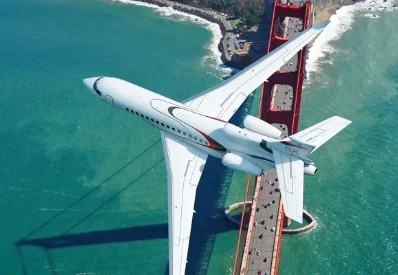
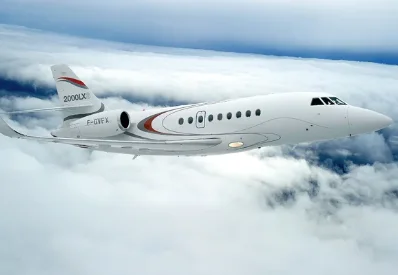
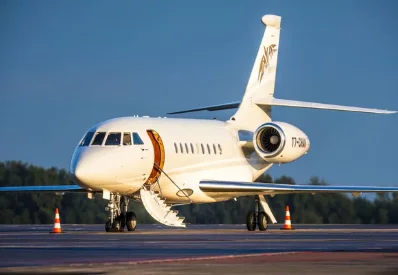
The Falcon 900DX can be considered a tri-jet evolution of the now out-of-production Falcon 50. It was launched in 2005 and uses the same wings as its predecessors but offers a much wider and longer fuselage, resulting in a similar cabin size to the Falcon 7X, the flagship of Dassault's Falcon range. There are many adaptations of this aircraft: the 900, 900B and 900C being older versions, the 900EX being an older long-range version and the 900LX being the most recent long-range version. The DX, although categorised as Super Large as opposed to Long Range, can still easily fly from Paris to Chicago non-stop and can maintain an impressive cruise speed of 878 km/h. It features an excellent interior which is divided into three distinct areas, seating up to 13 passengers in a day configuration and sleeping up to 7 in comfortable beds. It is also fully equipped with all the amenities you would expect to find on board a top-of-the-range jet, including a full front galley.
Super Large Jet
| Specification | Value |
|---|---|
| Manufacturer | Dassault |
| Category | Super Large Jet |
| Range* | 7593 km 4100 NM |
| Cruise speed | 878 km/h 474 kts |
| Seats** | 8-14 |
| Suitcases | 12 |


* with IFR reserves
** in standard configuration
Aircraft Pictures


History
The Falcon 900DX entered production in 2005 as Dassault's response to customer demand for improved avionics and operational efficiency. The aircraft was designed to replace the 900C in the Falcon lineup.
Deliveries began in 2005, continuing until 2010. The 900DX featured the proven TFE731-60 turbofans from the 900EX but without the centreline fuel tanks, creating a shorter-range variant optimized for specific mission profiles.
A key advancement was the integration of Honeywell Primus Epic EASy avionics, developed jointly with Dassault. This digital cockpit system reduced pilot workload while enhancing safety and operational capability compared to earlier analog systems.
The 900DX filled an important niche in the Falcon 900 family, offering modern avionics and proven engine performance in a configuration suited for operators who didn't require maximum range. Production ceased in 2010 as Dassault focused on the 900LX variant with winglet technology.
Technical Specifications
General information
| Model name | Falcon 900DX |
|---|---|
| Manufacturer | Dassault Aviation |
| Aircraft category | super large jet |
| ICAO Designator | F900 |
| Start/End of Production | 2005 - 2010 |
| Number of pilot(s) | 2 |
Performances
| Range (with IFR reserves) | 4100 NM (7593 km) |
|---|---|
| Ferry range | 4500 NM (8334 km) |
| Cruise speed | 474 kts (878 km/h) |
| Max Operating Speed – VMO | 370 KIAS |
| Max Mach Operating Speed - MMO | Mach 0.87 |
| Long-Range Cruise Speed - LRC | 435 KTAS |
| Approach Speed | 110 kts |
| Takeoff Distance | 1490 m |
| Average Landing Distance | 730 m |
| Service Ceiling | 51000 ft |
| Thrust | 5000 lbf |
Aircraft technology
| Engine type | Turbofan |
|---|---|
| Engine(s) | 3 x Honeywell TFE731-60 |
| Avionics | Honeywell Primus Epic EASy |
Dimensions and capacity
| Aircraft length | 20.21 m |
|---|---|
| Aircraft height | 7.55 m |
| Wing span | 19.33 m |
| Cabin height | 1.89 m (6.2 ft) |
| Cabin length | 10.11 m (33.17 ft) |
| Cabin width | 2.34 m (7.7 ft) |
| Baggage volume | 3.6 m3 |
| Seats (standard config) | 8-14 |
| Seats (max) | 19 |
| Suitcases | 12 |
| Carry-on luggage | 10 |
| Maximum payload | 2297 kg |
| Maximum TakeOff Weight - MTOW | 21183 kg |
| Maximum Landing Weight - MLW | 19142 kg |
FAQ
What is the cruising speed of the Falcon 900DX?
The Falcon 900DX cruises at 878 km/h (474 knots), positioning it competitively within the super large jet category. At this speed, the aircraft can complete the London to Rome route in approximately 1 hour and 40 minutes, making it highly efficient for European business travel.
Does the Falcon 900DX have more range than the Legacy 600?
Yes, the Falcon 900DX provides significantly more range than the Legacy 600. The 900DX offers 7,593 km (4,100 nautical miles) compared to the Legacy 600's 6,019 km (3,250 nautical miles), representing a range advantage of approximately 1,574 km (850 nautical miles). This additional range allows the 900DX to complete longer non-stop flights that would require refuelling stops in the Legacy 600.
How many passengers can the Falcon 900DX accommodate?
The Falcon 900DX seats 12-14 passengers in its standard configuration, with a maximum capacity of 19 passengers. The cabin measures 10.03 metres in length, 2.34 metres in width, and 1.88 metres in height, divided into three distinct areas. In night configuration, the aircraft can accommodate up to 7 passengers in comfortable sleeping arrangements.
What distinguishes the Falcon 900DX's avionics system?
The Falcon 900DX features Honeywell Primus Epic EASy avionics, a digital cockpit system developed jointly with Dassault. This advanced avionics package reduces pilot workload through intelligent automation whilst enhancing safety and operational capability compared to earlier analogue systems. The EASy system was specifically integrated to improve operational efficiency and represented a significant technological advancement when introduced in 2005.
What is the maximum range of the Falcon 900DX?
The Falcon 900DX offers a maximum range of 7,593 km (4,100 nautical miles) under NBAA IFR conditions. This range capability allows direct flights on routes such as London to Dubai or New York to São Paulo without refuelling stops, providing flexibility for intercontinental business travel.