Bombardier Learjet 75
The Learjet 75 was announced by Bombardier at EBACE 2012 in Geneva and its production started one year later, in May 2013. The 100th model was delivered in June 2017, which was also the 3000th Learjet to be delivered. Replacing the Learjet 45 series, the Learjet 75 provides improved avionics, winglets and engines, allowing for better fuel efficiency, increased range and reduced cabin noise.
It has an operating ceiling of 51,000 ft, enabling smoother and faster flights. With a 940 kph high-speed cruise, this private jet has one of the fastest cruising speeds among Super Light Jets. It can reach destinations up to 3,778 km away when flying with four passengers and two crew, and has a maximum capacity of 9 passengers.
The Learjet 75’s most typical layout is the 8-seater double-club, the only flat-floor cabin in such a configuration within Super Light Jets. Since 2016, the Learjet 75 has also been the only aircraft within the Super Light Jet category to be equipped with a pocket door separating the cabin from the cockpit and the galley area. This reduces noise levels inside the cabin even further and creates a distinct private living space for passengers.
Super Light Jet
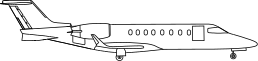
| Specification | Value |
|---|---|
| Manufacturer | Bombardier |
| Category | Super Light Jet |
| Range* | 3778 km 2040 NM |
| Cruise speed | 861 km/h 465 kts |
| Seats** | 8 |
| Suitcases | 5 |


* with IFR reserves
** in standard configuration
Aircraft Pictures

History
Bombardier announced the Learjet 75 at the European Business Aviation Convention (EBACE) in Geneva in May 2012. The aircraft was developed from the Learjet 40 and 45 platforms, featuring significant technological and performance upgrades.
The development programme utilized five flight test aircraft, including modified Learjet 40XR and 45XR variants for different testing phases. The first production aircraft was powered up in August 2012, with the modern Bombardier Vision flight deck activated as the programme progressed toward service entry.
Key improvements included aerodynamic enhancements that reduced drag by 2%, weight reduction of 200 pounds in the nose section, and canted winglets adapted from the Global 7500/8000. These modifications resulted in a 4% increase in range compared to predecessor models.
The Learjet 75 received FAA type certification on November 14, 2013, followed by EASA certification in September 2014. The aircraft featured touchscreen-controlled Garmin G5000 avionics and a modernized interior. The 100th Learjet 75 was delivered in June 2017, and the type became the final Learjet model when the last aircraft was manufactured in January 2022 and delivered on March 28, 2022.
Technical Specifications
General information
| Model name | Learjet 75 |
|---|---|
| Manufacturer | Bombardier |
| Aircraft category | super light jet |
| ICAO Designator | LJ75 |
| Start/End of Production | 2013 - 2022 |
| Number of pilot(s) | 2 |
Performances
| Range (with IFR reserves) | 2040 NM (3778 km) |
|---|---|
| Ferry range | 2050 NM (3797 km) |
| Cruise speed | 465 kts (861 km/h) |
| Max Operating Speed – VMO | 330 KIAS |
| Max Mach Operating Speed - MMO | Mach 0.81 |
| Long-Range Cruise Speed - LRC | 437 KTAS |
| Approach Speed | 125 kts |
| Takeoff Distance | 1350 m |
| Average Landing Distance | 710 m |
| Rate of Climb | 4000 ft/min |
| Service Ceiling | 51000 ft |
| Thrust | 3850 lbf |
Aircraft technology
| Engine type | Turbofan |
|---|---|
| Engine(s) | 2 |
| Avionics | Garmin G5000 |
Dimensions and capacity
| Aircraft length | 17.7 m |
|---|---|
| Aircraft height | 4.3 m |
| Wing span | 15.5 m |
| Cabin height | 1.53 m (5.00 ft) |
| Cabin length | 5.82 m (19.10 ft) |
| Cabin width | 1.25 m (4.11 ft) |
| Baggage volume | 1.84 m3 |
| Seats (standard config) | 8 |
| Seats (max) | 9 |
| Suitcases | 5 |
| Carry-on luggage | 7 |
| Maximum payload | 1300 kg |
| Maximum TakeOff Weight - MTOW | 9750 kg |
| Maximum Landing Weight - MLW | 8700 kg |
| Fuel capacity | 3550 L |
FAQ
What is the range of the Learjet 75?
The Learjet 75 has an NBAA IFR range of 3,778 km (2,040 nm). This allows for direct connections such as London to Athens, Paris to Istanbul, or Geneva to Marrakech. For longer itineraries like London to Dubai, a technical stop is required, but the aircraft comfortably handles most European routes without refuelling.
How comfortable is the Learjet 75 cabin?
The cabin of the Learjet 75 offers a flat floor, ample legroom, and large windows that brighten the interior. Seating is typically arranged for productivity and comfort, with folding tables for meetings or dining. The quiet environment and efficient layout make the jet suitable for both business travellers and leisure groups on shorter trips.
When was the Learjet 75 introduced and how long was it produced?
The Learjet 75 was unveiled in 2012 and received certification in 2013. It was in production until 2022, marking the final chapter of the Learjet family. This decade of service ensured modern avionics, updated aerodynamics with winglets, and cabin refinements that distinguish it from earlier Learjet designs.
How does the Learjet 75 compare to the Embraer Phenom 300?
The Learjet 75 offers a higher cruise speed of Mach 0.81 and an operating ceiling of 51,000 feet, allowing it to fly above most air traffic. Its cabin seats 8 passengers (standard configuration), with a flat floor and four executive tables for work or dining. The Phenom 300 seats 6 passengers (standard configuration) and has an NBAA IFR range of 3,723 km (2,010 nm), slightly less than the Learjet 75. The Phenom 300 is generally more economical to operate, whereas the Learjet 75 emphasises speed and cabin comfort.
How does the Learjet 75 compare to the Citation XLS+?
The Learjet 75 flies slightly faster than the Citation XLS+ and has a higher maximum altitude. It also offers a slightly longer NBAA IFR range of 3,778 km (2,040 nm) compared to the XLS+ at 3,889 km (2,100 nm). The XLS+ provides a larger cabin, so passengers often weigh the Learjet’s speed and climb performance against the XLS+’s interior volume, depending on the mission profile.