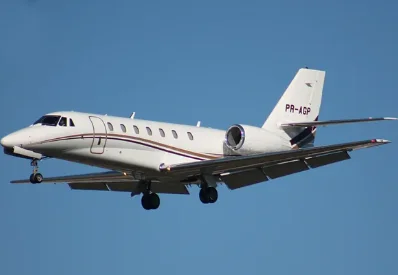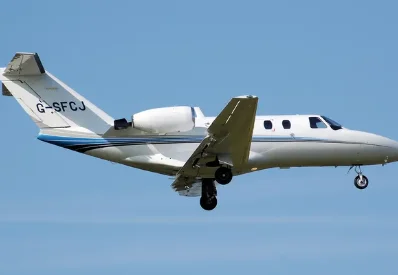
Cessna Citation VII
Produced by the American manufacturer, Cessna, the Citation VII is categorised as a Midsize Jet and, launched in 1991, is an improved and upgraded version of the Citation III. The aircraft is more spacious and luxurious than its predecessor, capable of accommodating 7 passengers in its standard configuration and up to 13 in other variations thanks to its completely remodelled fuselage. The cabin’s soundproofing has also been redeveloped to increase on-board comfort, and increased engine performance explains the Citation VII’s greater range and impressive fuel efficiency. For many years, the Citation VII was the most popular aircraft in its category, and it remains an excellent option because it provides an excellent balance between comfort and price.
Super Light Jet
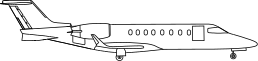
| Specification | Value |
|---|---|
| Manufacturer | Cessna |
| Category | Super Light Jet |
| Range* | 4111 km 2220 NM |
| Cruise speed | 852 km/h 460 kts |
| Seats** | 7 |
| Suitcases | 8 |


* with IFR reserves
** in standard configuration
Aircraft Pictures


History
The Citation VII emerged as the final evolution of Cessna's Citation 650 series, building upon the successful Citation III platform. The aircraft made its first flight in February 1991, representing significant improvements in engine technology and performance.
The VII featured upgraded Honeywell TFE731-4 engines producing 4,140 pounds of thrust, equipped with digital electronic engine controls (DEECs) - the precursor to modern FADEC systems. These engines provided automatic overspeed and overtemperature protection, reducing pilot workload during critical flight phases.
Production began in 1992 and continued through 2000, with 119 aircraft delivered. The VII offered enhanced takeoff, climb, and cruise performance compared to the Citation III, along with increased maximum takeoff weight and improved avionics systems.
The Citation VII also featured upgraded creature comforts and cabin improvements, distinguishing it from earlier 650 series variants. The aircraft represented the culmination of the Citation III/VI/VII development programme, with 360 total aircraft delivered across all variants before production ended in 2000, marking the end of Cessna's first-generation large-cabin Citation family.
Technical Specifications
General information
| Model name | Citation VII |
|---|---|
| Manufacturer | Cessna |
| Aircraft category | super light jet |
| ICAO Designator | C650 |
| Start/End of Production | 1992 - 2000 |
| Number of pilot(s) | 2 |
Performances
| Range (with IFR reserves) | 2220 NM (4111 km) |
|---|---|
| Ferry range | 2220 NM (4111 km) |
| Cruise speed | 460 kts (852 km/h) |
| Max Operating Speed – VMO | 305 KIAS |
| Max Mach Operating Speed - MMO | Mach 0.85 |
| Long-Range Cruise Speed - LRC | 417 KTAS |
| Approach Speed | 110 kts |
| Takeoff Distance | 1370 m |
| Average Landing Distance | 940 m |
| Rate of Climb | 3000 ft/min |
| Service Ceiling | 43000 ft |
| Thrust | 4080 lbf |
Aircraft technology
| Engine type | Turbofan |
|---|---|
| Engine(s) | 2 |
| Avionics | Honeywell SPZ-8000 EFIS |
Dimensions and capacity
| Aircraft length | 16.91 m |
|---|---|
| Aircraft height | 5.44 m |
| Wing span | 16.3 m |
| Cabin height | 1.73 m (5.67 ft) |
| Cabin length | 5.61 m (18.42 ft) |
| Cabin width | 1.68 m (5.50 ft) |
| Baggage volume | 1.44 m3 |
| Seats (standard config) | 7 |
| Seats (max) | 9 |
| Suitcases | 8 |
| Carry-on luggage | 7 |
| Maximum payload | 1000 kg |
| Maximum TakeOff Weight - MTOW | 10183 kg |
| Maximum Landing Weight - MLW | 9300 kg |
| Fuel capacity | 4850 L |
FAQ
How does the Citation VII compare to the Citation Latitude?
The Citation Latitude is the modern midsize successor to earlier jets like the Citation VII. While the Citation VII flies about 4,111 km (2,220 nm), the Latitude extends this to around 4,960 km (2,678 nm). The Latitude also introduces a wider, flat-floor cabin with advanced avionics and seats 9 passengers (standard configuration), whereas the Citation VII retains its classic midsize layout and seats 7 passengers (standard configuration). Both serve similar missions, but the Latitude provides more range and more space and comfort in today’s charter market.
Is the Citation VII still available for charter today?
Although production ended in 2000, many Citation VIIs remain in active service through charter fleets. Their balance of speed, cabin comfort, and cost efficiency keeps them relevant in the midsize jet category.
How does the Citation VII compare to the Citation VI?
The Citation VII is an improved version of the Citation VI, fitted with more powerful Honeywell TFE731-4R-2S engines. These engines increased climb performance and raised cruise speed from about 796 km/h (430 kts) on the Citation VI to around 852 km/h (460 kts) on the Citation VII. Cabin comfort was also refined with better soundproofing. For charter clients, this translates into faster travel times and a quieter in-flight experience.
What is the range of the Citation VII?
The Citation VII can fly up to 4,111 km (2,220 nm) under standard conditions. This range covers typical medium-haul missions, from city pairs within Europe such as London to Athens or Paris to Stockholm, to domestic routes in the United States like New York to Dallas. It is often chosen for both business and leisure travel across these distances.