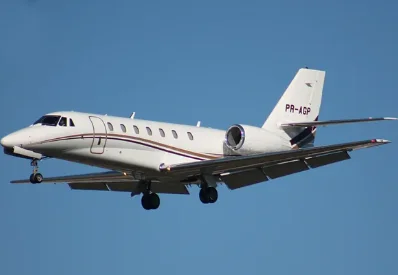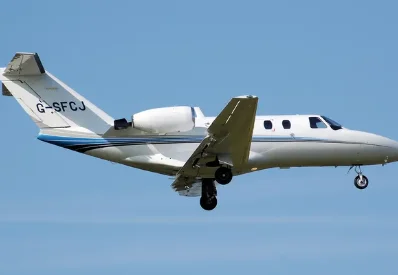
Cessna Citation Bravo
From 1997 until its production came to an end in 2006, the Cessna Citation Bravo was one of the most popular and successful light business jets available on the market. Known for its reliability, more than 300 of this aircraft, an upgrade of the Citation II, are still in operation. The Bravo features a comfortable interior, with a cabin length of 4.8m. In spite of not being the most recent aircraft, the Bravo comfortably seats up to 7 passengers in a Club 4 arrangement and 3 individual seats. In fact, many of the Bravos in operation today have been refurbished since rolling off the production line, optimising their level of comfort. This aircraft also provides a good service, easily connecting major European cities in good time, as well as being certified for steep approach, giving it access to airports such as London City and Lugano. Overall, although this light jet may not be the most recent of the Cessna range, it is still capable of providing an excellent short-haul flight service.
Light jet
| Specification | Value |
|---|---|
| Manufacturer | Cessna |
| Category | Light jet |
| Range* | 2769 km 1495 NM |
| Cruise speed | 739 km/h 399 kts |
| Seats** | 7 |
| Suitcases | 4 |


* with IFR reserves
** in standard configuration
Aircraft Pictures

History
The Cessna Citation Bravo emerged as a significant upgrade to the Citation S/II series, combining a stretched fuselage with new avionics and more powerful engines. The aircraft made its first flight on April 25, 1995, representing Cessna's response to market demand for improved performance in the mid-size category.
The Bravo featured Pratt & Whitney Canada PW530A turbofans, providing substantially more power than previous Citation II variants. The aircraft received certification in August 1996, with first customer deliveries beginning in February 1997.
Key improvements included upgraded avionics systems and enhanced performance capabilities that made the aircraft suitable for a broader range of missions. The Bravo maintained the Citation family's reputation for single-pilot certification while offering increased payload and range flexibility.
Production continued for nearly a decade, with 337 aircraft manufactured before the last Citation Bravo rolled off the production line in late 2006. The aircraft served as an important bridge between the earlier Citation II series and more modern Citation variants, helping maintain Cessna's leadership in the business jet market.
Technical Specifications
General information
| Model name | Citation Bravo |
|---|---|
| Manufacturer | Cessna |
| Aircraft category | light jet |
| ICAO Designator | C55B |
| Start/End of Production | 1996 - 2006 |
| Number of pilot(s) | 2 |
Performances
| Range (with IFR reserves) | 1495 NM (2769 km) |
|---|---|
| Ferry range | 2000 NM (3704 km) |
| Cruise speed | 399 kts (739 km/h) |
| Max Operating Speed – VMO | 275 KIAS |
| Max Mach Operating Speed - MMO | Mach 0.7 |
| Long-Range Cruise Speed - LRC | 342 KTAS |
| Approach Speed | 110 kts |
| Takeoff Distance | 1097 m |
| Average Landing Distance | 767 m |
| Rate of Climb | 3196 ft/min |
| Service Ceiling | 45000 ft |
| Thrust | 2887 lbf |
Aircraft technology
| Engine type | Turbofan |
|---|---|
| Engine(s) | 2 x Pratt & Whitney Canada PW530A |
| Avionics | Honeywell Primus 1000 |
Dimensions and capacity
| Aircraft length | 14.4 m |
|---|---|
| Aircraft height | 4.6 m |
| Wing span | 15.8 m |
| Cabin height | 1.45 m (4.75 ft) |
| Cabin length | 4.88 m (16.0 ft) |
| Cabin width | 1.45 m (4.75 ft) |
| Baggage volume | 2.07 m3 |
| Seats (standard config) | 7 |
| Seats (max) | 11 |
| Suitcases | 4 |
| Carry-on luggage | 6 |
| Maximum payload | 816 kg |
| Maximum TakeOff Weight - MTOW | 6713 kg |
Where the Cessna Citation Bravo flies most
The Cessna Citation II and Bravo family is an older design, and in 2025 it flew mostly outside this region. Only 12% of its commercial charter flights started or ended in Europe, the Middle East or North Africa.
Bratislava leads with 152 movements, ahead of Madrid (117) and Ankara (110). From Bratislava, the type links the Slovak capital to Prague and to the east of the country, including Košice and Poprad-Tatry, the airport for the High Tatras. Poprad-Tatry itself ranks 9th. Ankara is mainly connected to Bodrum, which recorded 84% of its movements between June and September.
Trips stay short to medium length. Half of the flights in the region covered less than 550 km, and 45% less than 500 km.
Based on LunaJets analysis of ADS-B flight tracking data. Contains information from adsb.lol, made available under the Open Database License (ODbL). The figures cover take-offs and landings on commercial charter flights (Part 135 / CAT) in 2025, in Europe, the Middle East and North Africa. They include every version that shares the aircraft's type code, and a city needs at least 20 movements to be ranked.
Top Cities in 2025
In Central Europe, the Bravo often links Bratislava to the High Tatras. The Bratislava page and the Poprad-Tatry guide cover prices and airport details.
FAQ
How does the Citation Bravo compare to the Phenom 300?
The Embraer Phenom 300 is a newer light jet with an NBAA IFR range of 3,723 km (2,010 nm) compared to the Citation Bravo’s 2,769 km (1,495 nm). It also cruises faster and has a more modern cabin design. The Citation Bravo, however, is often chosen for its proven reliability, competitive charter pricing, and short-field performance that allows access to smaller regional airports.
What is the range of the Citation Bravo on charter flights?
The Citation Bravo has an NBAA IFR range of 2,769 km (1,495 nm), though the actual distance depends on payload, weather conditions, routing, and altitude. Under favourable circumstances, this permits nonstop routes such as Geneva to Madrid, London to Athens, or Paris to Stockholm.
What airports can the Citation Bravo access?
The Citation Bravo is equipped for short-field performance and is certified for steep-approach operations. This enables it to land at airports with limited runway length or demanding approach profiles, such as London City in the UK. These capabilities provide direct access to regional centres and leisure destinations that are often unavailable to larger aircraft.
Where does the Citation Bravo fit within the Citation family?
The Citation Bravo was developed as an upgrade to the Citation II and produced between 1996 and 2006. Within the Citation line, it sits between the earlier straight-jet designs and the more modern CJ series. What makes it distinctive is the combination of improved Pratt & Whitney PW530A engines, advanced Honeywell Primus 1000 avionics, and trailing-link landing gear, which gave smoother landings and access to shorter runways. It bridged the gap between classic Cessna light jets and the new-generation CJs that replaced it.