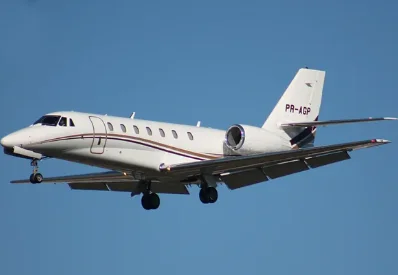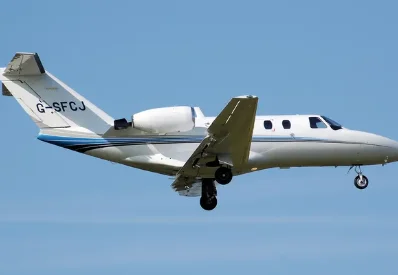
Cessna Citation II
Based on Citation I, the Cessna Citation II, specifically Model 550, and commonly abbreviated CE-550, is 1.14 metres longer than its predecessor, or 4.84 metres. This light corporate jet has a cabin volume of 8.27 cubic metres, usually configured to comfortably welcome eight passengers travelling for business. It offers generous baggage space and a maximum seating capacity of ten. Thanks to its powerful engines and increased fuel capacity, range and cruise speed are greater than those of the previous models. Indeed, it can carry an average of 11 pieces of luggage depending on their size and fly eight passengers at a maximum cruise speed of 692 kilometres per hour and cover a distance of up to 3,704 kilometres. However, factors like weather and aircraft configuration affect range and cruise speed.
The Cessna Citation II is one of the manufacturer’s best-selling private aircraft to date; it first flew in 1977 and was certified in 1978. It can be configured to be operated by a single pilot, which facilitates coordination and reduces travel costs.
Ideal for a party of six corporate travellers, it is also often hired for individuals or families.
Light jet
| Specification | Value |
|---|---|
| Manufacturer | Cessna |
| Category | Light jet |
| Range* | 3204 km 1730 NM |
| Cruise speed | 696 km/h 376 kts |
| Seats** | 7 |
| Suitcases | 5 |


* with IFR reserves
** in standard configuration
Aircraft Pictures


History
Cessna announced the Citation II in September 1976 as a stretched development of the original Citation, addressing market demand for increased cabin space and payload capacity. The aircraft represented the second generation of the Citation family.
The Model 550 Citation II made its first flight on January 31, 1977, featuring a longer fuselage that provided additional passenger seating and baggage space. The aircraft retained the straight-wing configuration and reliable systems architecture of the original Citation.
FAA certification was achieved in March 1978, enabling first deliveries to begin shortly thereafter. The Citation II incorporated lessons learned from the original Citation's operational experience while maintaining the family's emphasis on simplicity and single-pilot capability.
The Citation II became one of the most successful variants in the family, with production continuing through various improvements including the Citation II/SP (single-pilot), Citation S/II, and Citation Bravo. The aircraft established the foundation for Cessna's continued dominance in the business jet market, contributing to the Citation family's achievement of over 7,500 deliveries in its first fifty years of production.
Technical Specifications
General information
| Model name | Citation II |
|---|---|
| Manufacturer | Cessna |
| Aircraft category | light jet |
| ICAO Designator | C550 |
| Start/End of Production | 1978 - 1995 |
| Number of pilot(s) | 1-2 |
Performances
| Range (with IFR reserves) | 1730 NM (3204 km) |
|---|---|
| Ferry range | 1998 NM (3700 km) |
| Cruise speed | 376 kts (696 km/h) |
| Max Operating Speed – VMO | 275 KIAS |
| Max Mach Operating Speed - MMO | Mach 0.7 |
| Long-Range Cruise Speed - LRC | 307 KTAS |
| Approach Speed | 106 kts |
| Takeoff Distance | 1052 m |
| Average Landing Distance | 720 m |
| Rate of Climb | 3040 ft/min |
| Service Ceiling | 43000 ft |
| Thrust | 2500 lbf |
Aircraft technology
| Engine type | Turbofan |
|---|---|
| Engine(s) | 2 x Pratt & Whitney Canada JT15D-4B |
| Avionics | Garmin 700 |
Dimensions and capacity
| Aircraft length | 14.5 m |
|---|---|
| Aircraft height | 4.5 m |
| Wing span | 15.9 m |
| Cabin height | 1.46 m (4.79 ft) |
| Cabin length | 4.8 m (15.75 ft) |
| Cabin width | 1.49 m (4.89 ft) |
| Baggage volume | 2.18 m3 |
| Seats (standard config) | 7 |
| Seats (max) | 10 |
| Suitcases | 5 |
| Carry-on luggage | 4 |
| Maximum payload | 1134 kg |
| Maximum TakeOff Weight - MTOW | 6849 kg |
FAQ
What is the range of the Citation II?
The Citation II has a range of about 3,204 km (1,730 nm), depending on payload and weather conditions. This permits nonstop flights such as London to Rome or Paris to Budapest.
Can the Citation II use smaller airports?
Yes. The Citation II was designed with short-field performance in mind. At sea level, it typically requires about 3,500 feet (1,067 m) of runway for takeoff and around 2,200 feet (670 m) for landing. This permits operations at airports with limited runway length, opening access to destinations such as Cannes Mandelieu, Lugano, or Sion, often closer to resorts or alpine regions than larger international hubs.
How does the Citation II compare to the Citation CJ2?
The Citation CJ2, introduced in 2000, is a newer generation light jet that represents a step forward from the Citation II. The Citation II has a range of about 3,204 km (1,730 nm) and cruises at 713 km/h (385 kts), whereas the CJ2 can fly 2,463 km (1,330 nm) at 754 km/h (407 kts). At sea level, the Citation II requires about 1,067 m (3,500 ft) of runway for takeoff, compared with roughly 1,024 m (3,360 ft) for the CJ2. Both aircraft seat 7 passengers (standard configuration), but the CJ2 benefits from a more modern cabin layout and updated avionics.
How does the Citation II compare to the Citation S/II?
The Citation S/II, introduced in the mid-1980s, was an upgraded version of the Citation II. It came with a supercritical wing design that improved aerodynamics, giving it a higher cruise speed and slightly extended range. The Citation II cruises at 696 km/h (376 kts) with a range of 3,204 km (1,730 nm), while the S/II offered incremental improvements that made it more efficient on longer routes. Both seat 7 passengers (standard configuration), but the S/II provides smoother performance and better fuel efficiency.
How fast does the Citation II fly?
The Citation II cruises at about 713 km/h (385 kts). While not as fast as newer light jets, its speed is sufficient for short and medium routes. Passengers save time by flying directly between regional airports, avoiding long ground transfers through larger hubs.