



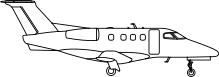
Beechcraft Beechjet 400A
The Beechjet 400A boasts various design upgrades compared to its predecessor, the original 400, and represents a more efficient aircraft. The improvements include a greater maximum landing weight, more fuel storage, increased payload and flight ceiling, and an expanded cabin area as the new fuel tank is located under the floor. Thanks to the addition of sound-dampening materials, the cabin offers a quieter environment. It is considered a more comfortable Light Business Jet than the previous model, with a spacious interior: 4.75 metres long, 1.46 metres high and 1.49 metres wide. It welcomes a crew of two, and seven or eight passengers able to enjoy swivel seats that can be converted to beds, for optimal sleep. The cabin counts a rear lavatory, storage space for baggage granting passengers in-flight access, and a refreshment cabinet. In addition to these design refinements, this jet also holds more powerful engines, covering a range of 2,778 kilometres with a maximum cruise speed of 826 kilometres per hour. Even though range and speed vary according to factors such as the number of passengers and the aircraft’s configuration.
It first flew in 1989 and was manufactured by Beechcraft until the introduction of its successors, the Hawker 400 and 400XP. However, the Beechjet 400A remains a great choice among the Light Jet category for corporate and leisure travel.
Light Jet
| Specification | Value |
|---|---|
| Manufacturer | Beechcraft |
| Category | Light Jet |
| Range* | 2185 km 1180 NM |
| Cruise speed | 832 km/h 449 kts |
| Seats** | 7 |
| Suitcases | 5 |


* with IFR reserves
** in standard configuration
Aircraft Pictures


History
The Beechjet 400A has an unusual development history, beginning life as the Mitsubishi MU-300 Diamond. Mitsubishi Heavy Industries designed the aircraft as their flagship corporate jet, with the first flight taking place on August 29, 1978. The FAA certificated the Diamond in 1981, with over 90 aircraft manufactured in Japan and assembled at Mitsubishi's San Angelo, Texas facility.
In 1985, Mitsubishi sold the aircraft rights and unfinished airframes to Beechcraft. The company redesignated the aircraft as the Beechjet 400 and received FAA certification in May 1986. The first Beechcraft-assembled aircraft rolled out the same month, powered by Pratt & Whitney Canada JT15D-5 engines.
Beechcraft introduced the improved 400A variant in September 1989, featuring more powerful engines, Rockwell Collins Pro Line 4 avionics, higher gross weight, and an enlarged cabin. The upgrade provided longer range and enhanced luxury appointments compared to the original 400.
The aircraft underwent another name change in 1993 when Raytheon purchased the Hawker business jet line, rebranding the Beechjet 400A as the Hawker 400. Despite multiple ownership changes, production continued successfully, with over 950 aircraft delivered by 2009 across all variants of this enduring design.
Technical Specifications
General information
| Model name | Beechjet 400A |
|---|---|
| Manufacturer | Beechcraft |
| Aircraft category | light jet |
| ICAO Designator | BE40 |
| Start/End of Production | 1990 - 2008 |
| Number of pilot(s) | 2 |
Performances
| Range (with IFR reserves) | 1180 NM (2185 km) |
|---|---|
| Ferry range | 1519 NM (2813 km) |
| Cruise speed | 449 kts (832 km/h) |
| Max Operating Speed – VMO | 320 KIAS |
| Max Mach Operating Speed - MMO | Mach 0.79 |
| Long-Range Cruise Speed - LRC | 410 KTAS |
| Approach Speed | 111 kts |
| Takeoff Distance | 1308 m |
| Average Landing Distance | 902 m |
| Rate of Climb | 3770 ft/min |
| Service Ceiling | 45000 ft |
| Thrust | 2965 lbf |
Aircraft technology
| Engine type | Turbofan |
|---|---|
| Engine(s) | 2 x Pratt & Whitney Canada JT15D-5 |
| Avionics | Collins Pro Line 4 |
Dimensions and capacity
| Aircraft length | 14.8 m |
|---|---|
| Aircraft height | 4.24 m |
| Wing span | 13.3 m |
| Cabin height | 1.47 m (4.83 ft) |
| Cabin length | 4.75 m (15.6 ft) |
| Cabin width | 1.5 m (4.92 ft) |
| Baggage volume | 1.59 m3 |
| Seats (standard config) | 7 |
| Seats (max) | 11 |
| Suitcases | 5 |
| Carry-on luggage | 3 |
| Maximum payload | 975 kg |
| Maximum TakeOff Weight - MTOW | 7303 kg |
| Maximum Landing Weight - MLW | 7121 kg |
| Fuel capacity | 2785 L |
FAQ
How far can the Beechjet 400A fly without refuelling, and what is its maximum range?
The Beechjet 400A has an NBAA IFR range of 2,185 km (1,180 nm), depending on passenger load, weather, and speed. This covers regional routes such as New York–Miami, London–Athens, or Paris–Istanbul without a fuel stop.
How does the Beechjet 400A compare to the Embraer Phenom 300?
Both are light jets, but from different generations. The Beechjet 400A, introduced in the late 1980s, flies up to 2,185 km (1,180 nm) and seats 7 passengers (standard configuration). The Phenom 300, launched in the 2000s, extends range to around 3,723 km (2,010 nm), seats 6 passengers (standard configuration), and incorporates newer avionics and more efficient engines. The 400A remains relevant for shorter routes, while the Phenom 300 is chosen when additional range and newer technology are a priority.
What are the main differences between the Beechjet 400A and its successor, the Hawker 400XP?
The Hawker 400XP was introduced as an improved version of the Beechjet 400A. It comes with more powerful engines, a higher maximum take-off weight, and upgraded avionics. The interior was also reworked for better passenger comfort, while fuel efficiency improved slightly compared with the 400A.
What are the take-off and landing distance requirements of the Beechjet 400A, and does it have steep approach certification?
The Beechjet 400A generally needs around 4,900 feet (1,490 m) of runway for take-off and about 3,800 feet (1,160 m) for landing, depending on conditions. It is not certified for steep approach operations, so it cannot use airports like London City. Even so, these performance figures permit access to a wide range of regional and business aviation airports.


