Cessna Citation V
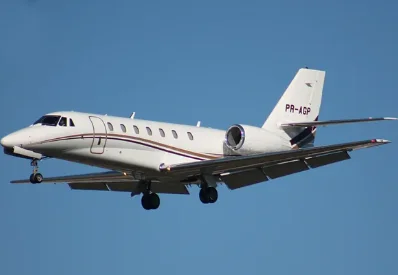
The Cessna Citation V belongs to the category of Midsize Jets and was launched in 1987 as the successor to the Citation II, offering a greater overall performance thanks to a wide range of upgrades. It features a more spacious cabin that can comfortably accommodate 8 passengers in its standard configuration and up to 9 in certain versions. The interior is well soundproofed to make for a very relaxing flight. Its high-performance engines give it one of the most impressive ranges of any aircraft in its class and the Citation V also benefits from an advanced avionics system to ensure a comfortable flight experience. Development and upgrading of the Citation V led to the creation of the Citation Ultra and Citation Excel, providing the perfect balance between price, efficiency and comfort for which the Citation range of aircraft is well known.
Light jet
| Specification | Value |
|---|---|
| Manufacturer | Cessna |
| Category | Light jet |
| Range* | 3630 km 1960 NM |
| Cruise speed | 787 km/h 425 kts |
| Seats** | 8 |
| Suitcases | 6 |


* with IFR reserves
** in standard configuration
Aircraft Pictures

History
The Cessna Citation V (Model 560) emerged as a stretched development of the Citation S/II, designed to offer increased cabin space and passenger capacity. The first prototype flew in August 1987, with FAA certification achieved on December 9, 1988.
Production commenced in 1989 and continued until 1994, establishing the Citation V as one of the longest-running variants in the Citation family. During this 5-year production run, 774 aircraft were manufactured, making it one of the most successful mid-size business jets ever built.
Cessna introduced the upgraded Citation V Ultra in September 1993, receiving FAA certification in June 1994. The Ultra featured redesigned Pratt & Whitney JT15D-5D engines with new compressors, high-pressure turbines, and solid machined fan disks, increasing thrust to 3,045 pounds while reducing fuel consumption and weight.
The evolution continued with the Citation Ultra Encore, announced at the 1998 NBAA convention. This variant featured new Pratt & Whitney PW535 engines and received certification in April 2000. The Citation V series demonstrated Cessna's ability to continuously improve proven designs, contributing significantly to the Citation family's dominance in business aviation.
Technical Specifications
General information
| Model name | Citation V |
|---|---|
| Manufacturer | Cessna |
| Aircraft category | light jet |
| ICAO Designator | C560 |
| Start/End of Production | 1989 - 1994 |
| Number of pilot(s) | 2 |
Performances
| Range (with IFR reserves) | 1960 NM (3630 km) |
|---|---|
| Ferry range | 2090 NM (3871 km) |
| Cruise speed | 425 kts (787 km/h) |
| Max Operating Speed – VMO | 292 KIAS |
| Max Mach Operating Speed - MMO | Mach 0.76 |
| Long-Range Cruise Speed - LRC | 350 KTAS |
| Approach Speed | 103 kts |
| Takeoff Distance | 970 m |
| Average Landing Distance | 854 m |
| Rate of Climb | 3460 ft/min |
| Service Ceiling | 45000 ft |
| Thrust | 2900 lbf |
Aircraft technology
| Engine type | Turbofan |
|---|---|
| Engine(s) | 2 |
| Avionics | Collins EFIS-84 |
Dimensions and capacity
| Aircraft length | 14.9 m |
|---|---|
| Aircraft height | 4.5 m |
| Wing span | 15.9 m |
| Cabin height | 1.46 m (4.80 ft) |
| Cabin length | 5.28 m (17.33 ft) |
| Cabin width | 1.47 m (4.83 ft) |
| Baggage volume | 0.68 m3 |
| Seats (standard config) | 8 |
| Seats (max) | 11 |
| Suitcases | 6 |
| Carry-on luggage | 6 |
| Maximum payload | 1000 kg |
| Maximum TakeOff Weight - MTOW | 7200 kg |
| Maximum Landing Weight - MLW | 6895 kg |
| Fuel capacity | 3680 L |
FAQ
How does the Citation V compare to the Citation Encore?
The Citation Encore is an upgraded version of the Citation V, with more efficient Pratt & Whitney PW535 engines, giving it better climb performance and a longer range of 3,098 km (1,673 nm) compared to the Citation V’s 3,630 km (1,960 nm). Cruise speeds are very similar, with the Encore at 789 km/h (426 kts) and the Citation V at 787 km/h (425 kts). Both jets seat 8 passengers (standard configuration) in similar layouts, but the Encore benefits from newer avionics, lower operating costs, and smoother performance. The Citation V remains a reliable light jet, while the Encore reflects refinements made for improved efficiency and comfort.
Does the Citation V have steep-approach certification?
The Citation V was not certified for steep-approach operations at airports such as London City, which require special approval. Later Citation models, including the CJ2 and newer variants, gained this capability. For clients needing access to airports with challenging approach profiles, more recent Cessna aircraft may be more appropriate.
What is the cabin experience like on the Citation V?
The Citation V is configured for 8 passengers (standard configuration), though some layouts can accommodate up to 11. The cabin provides generous headroom, wide seating, and a quiet atmosphere, with a club arrangement and forward-facing chairs as the common setup. Amenities include a mini-galley, enclosed lavatory, and a rear baggage compartment with space for several suitcases.
What is the range of the Citation V?
The Citation V can fly up to 3,630 km (1,960 nm) depending on payload and weather. This makes nonstop routes such as London to Milan or New York to Miami practical. The range places it among the longer-legged light jets.
How does the Citation V compare to the Citation VII?
Although both aircraft offer solid medium-haul performance, the Citation VII is a midsize jet with a longer range of 4,111 km (2,220 nm) and a higher cruise speed of 852 km/h (460 kts). The Citation V, by contrast, is a light jet with a cruise speed of 787 km/h (425 kts) and shorter reach. Clients typically choose between them based on cabin comfort and performance needs: the Citation VII for more space and speed, and the Citation V for efficiency on regional flights.