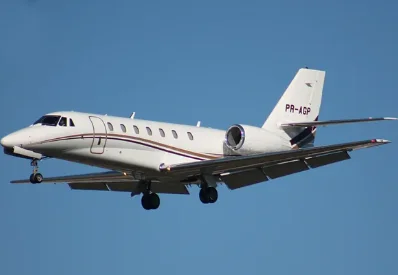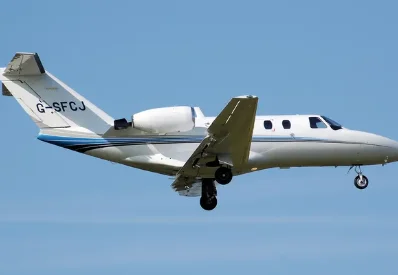
Cessna Citation III
The Citation III was the first aircraft in the Citation range of twin-engine midsize jets produced by the American manufacturer Cessna, a series of aircraft that is well known for having set a number of speed records. Launched in 1983, the 650 programme, which also included the Citation VI and VII, produced aircraft with greater performance and range than those of their predecessors, the Citation I and II. The Citation III is capable of seating 8 passengers in optimum comfort and can accommodate up to 9 in certain cabin configurations. The Citation III has received numerous upgrades over the years, leading to the creation of the Citation VI and VII, all offering a combination of service, price and comfort for an excellent overall flight experience.
Midsize Jet
| Specification | Value |
|---|---|
| Manufacturer | Cessna |
| Category | Midsize Jet |
| Range* | 3804 km 2054 NM |
| Cruise speed | 867 km/h 468 kts |
| Seats** | 8 |
| Suitcases | 8 |


* with IFR reserves
** in standard configuration
Aircraft Pictures


History
The Citation III marked a significant departure from earlier Citation designs when Cessna launched development in the late 1970s. The aircraft represented the company's entry into the large-cabin business jet market, featuring a completely new design philosophy compared to previous straight-wing Citations.
The Citation III made its first flight on May 30, 1979, introducing swept wings and T-tail configuration to the Citation family. The aircraft featured powerful Garrett TFE731-3B engines and pressurized cabin systems designed for high-altitude operations.
Certification came in April 1982, with first deliveries beginning the same year. The Citation III offered substantially improved performance over earlier Citations, with higher cruise speeds, increased range, and larger cabin capacity suitable for transcontinental missions.
The Citation III served as the foundation for subsequent large-cabin Citation developments, including the Citation VI and Citation VII. The aircraft's success validated Cessna's expansion into larger business jets, contributing to the Citation family's evolution into the world's most successful business aviation programme with over 8,000 aircraft delivered by 2022.
Technical Specifications
General information
| Model name | Citation III |
|---|---|
| Manufacturer | Cessna |
| Aircraft category | midsize jet |
| ICAO Designator | C650 |
| Start/End of Production | 1983 - 1992 |
| Number of pilot(s) | 2 |
Performances
| Range (with IFR reserves) | 2054 NM (3804 km) |
|---|---|
| Ferry range | 2348 NM (4349 km) |
| Cruise speed | 468 kts (867 km/h) |
| Max Operating Speed – VMO | 330 KIAS |
| Max Mach Operating Speed - MMO | Mach 0.84 |
| Long-Range Cruise Speed - LRC | 422 KTAS |
| Approach Speed | 89 kts |
| Takeoff Distance | 1440 m |
| Average Landing Distance | 780 m |
| Rate of Climb | 3805 ft/min |
| Service Ceiling | 51000 ft |
| Thrust | 3650 lbf |
Aircraft technology
| Engine type | Turbofan |
|---|---|
| Engine(s) | 2 x Garrett TFE731-3B |
| Avionics | Sperry/Honeywell SPZ-650 |
Dimensions and capacity
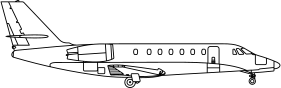
| Aircraft length | 16.9 m |
|---|---|
| Aircraft height | 5.1 m |
| Wing span | 16.3 m |
| Cabin height | 1.73 m (5.67 ft) |
| Cabin length | 5.60 m (18.33 ft) |
| Cabin width | 1.67 m (5.5 ft) |
| Baggage volume | 1.7 m3 |
| Seats (standard config) | 8 |
| Seats (max) | 13 |
| Suitcases | 8 |
| Carry-on luggage | 6 |
| Maximum payload | 750 kg |
| Maximum TakeOff Weight - MTOW | 10000 kg |
| Maximum Landing Weight - MLW | 9050 kg |
| Fuel capacity | 4600 L |
FAQ
How does the Citation III compare to the Citation CJ3?
The Citation III is a midsize jet, while the Citation CJ3 is a light jet. Both have a similar range: around 3,804 km (2,054 nm) for the Citation III and 3,222 km (1,740 nm) for the CJ3. The Citation III cruises faster at 867 km/h (468 kts), compared to the CJ3’s 770 km/h (416 kts), and has a larger cabin that can seat up to 13 passengers. The CJ3, with seating for six to seven passengers, is lighter, more fuel-efficient, and can operate from shorter runways, making it practical for smaller airports.
How does the Citation III compare to the Citation VII?
The Citation VII was introduced as an enhanced development of the Citation III, using the same midsize airframe. It comes with upgraded Honeywell TFE731-4R engines, which improve climb rate and cruise performance. The cabin of the Citation VII is also quieter, with refinements in soundproofing and finish, giving passengers a more comfortable environment.
What airports can the Citation III operate from?
The Cessna Citation III has a standard takeoff distance of 5,030 ft (1,533 m) and a landing distance of 2,388 ft (728 m) at sea level. While it needs more runway length than light jets, it can still use many secondary airports across Europe. Airports such as Sion, Jersey, or Florence are within its typical operational scope for leisure and business trips.
Is the Citation III still a reliable choice today?
Although first introduced in the early 1980s, the Citation III remains valued for its speed, dependability, and balanced performance. Many are still in service for charter, particularly on medium-haul European routes, where its cabin size and performance remain competitive against newer midsize aircraft.
What is the range of the Citation III?
The Cessna Citation III can reach about 2,054 nautical miles (3,805 km) when flying with four passengers. Actual performance depends on conditions such as payload, weather, and routing. This range permits nonstop trips like Paris to Reykjavik or Geneva to Cairo.