
Embraer Praetor 500
Based on Embraer's Legacy 450, the super-fast Praetor 500 was introduced in 2018 at the NBAA-BACE tradeshow and is considered the most innovative and technologically advanced jet in its class. Functional, luxurious, and with an unmatched range within the Midsize Jet category, it was granted a Type Certificate by Brazil’s Civil Aviation Authority (ANAC) as well as by the European Union Aviation Safety Agency and the Federal Aviation Administration.
This Midsize Business Jet offers a 1.83-meter-tall cabin offers everything you might need to work or relax. It can welcome up to nine passengers on plush swivel seats which can be turned into fully flat beds and an optional two-place divan. Its generous luggage space includes a compartment accessible in-flight.
The Praetor 500 holds a cruise speed of 863 kilometres per hour and boasts an intercontinental range of up to 6,186 kilometres with an endurance of almost eight hours. In other words, passengers can enjoy non-stop flights from New York to London, London to Dubai, or Dubai to Bangkok, and fly from the U.S. west coast to Europe with only one stop. Since it can access short runways and airports with challenging final approaches, the Praetor 500 is able to serve a wide spectrum of routes and destinations. However, range and cruise speed vary due to weather conditions, aircraft configuration, and other factors.
Midsize jet
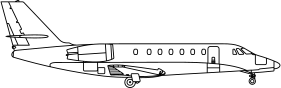
| Specification | Value |
|---|---|
| Manufacturer | Embraer |
| Category | Midsize jet |
| Range* | 6186 km 3340 NM |
| Cruise speed | 863 km/h 466 kts |
| Seats** | 7-9 |
| Suitcases | 10 |


* with IFR reserves
** in standard configuration
Aircraft Pictures


History
The Praetor 500 was introduced by Embraer in October 2018 at the NBAA convention as an enhanced version of the Legacy 450. The aircraft offered increased range through additional fuel capacity while maintaining the proven Legacy platform.
Flight testing began on September 13, 2018, with 80 hours accumulated by October. The rapid development timeline demonstrated Embraer's ability to efficiently enhance existing designs with customer-requested improvements.
The Praetor 500 received certification from Brazil's ANAC, followed by FAA and EASA approval in May 2019. The aircraft boosted fuel capacity from 12,108 to 13,058 pounds compared to the Legacy 450, extending range to 3,340 nautical miles.
Priced at $17 million, the Praetor 500 maintained the Legacy 450's advanced fly-by-wire system and flat-floor cabin while offering enhanced operational flexibility. Embraer provided existing Legacy 450 customers with an upgrade path to Praetor 500 configuration, ensuring continued support for the growing fleet.
Technical Specifications
General information
| Model name | Praetor 500 |
|---|---|
| Manufacturer | Embraer |
| Aircraft category | midsize jet |
| ICAO Designator | E545 |
| Start/End of Production | 2019 - Still in production |
| Number of pilot(s) | 2 |
Performances
| Range (with IFR reserves) | 3340 NM (6186 km) |
|---|---|
| Ferry range | 3700 NM (6852 km) |
| Cruise speed | 466 kts (863 km/h) |
| Max Operating Speed – VMO | 320 KIAS |
| Max Mach Operating Speed - MMO | Mach 0.83 |
| Long-Range Cruise Speed - LRC | 436 KTAS |
| Approach Speed | 109 kts |
| Takeoff Distance | 1287 m |
| Average Landing Distance | 635 m |
| Service Ceiling | 45000 ft |
| Thrust | 6540 lbf |
Aircraft technology
| Engine type | Turbofan |
|---|---|
| Engine(s) | 2 x Honeywell HTF7500E |
| Avionics | Rockwell Collins Pro Line Fusion |
Dimensions and capacity
| Aircraft length | 19.69 m |
|---|---|
| Aircraft height | 6.42 m |
| Wing span | 21.5 m |
| Cabin height | 1.83 m (6.0 ft) |
| Cabin length | 7.32 m (24.0 ft) |
| Cabin width | 2.08 m (6.83 ft) |
| Baggage volume | 4.25 m3 |
| Seats (standard config) | 7-9 |
| Seats (max) | 9 |
| Suitcases | 10 |
| Carry-on luggage | 8 |
| Maximum payload | 1325 kg |
| Maximum TakeOff Weight - MTOW | 17100 kg |
| Maximum Landing Weight - MLW | 15650 kg |
Where the Embraer Praetor 500 flies most
The Embraer Praetor 500 and Legacy 450 family flew only 300 commercial charter flights in Europe, the Middle East or North Africa in 2025. That was 24% of its charter flights worldwide, and seven cities pass the 20-movement mark.
Brussels leads with 87 movements, linked to Chambéry, St Tropez, London and Cannes. Thessaloniki follows with 59, mostly with Paris, Athens and Mykonos, and 59% of them took place between June and September. Paris (39) completes the top three.
St Tropez, 4th, is an unusual entry for a jet. Its La Môle airport has a short runway, yet the type recorded 26 movements there. In Cluj-Napoca, 20 of the 26 movements were flights to or from Vienna.
Based on LunaJets analysis of ADS-B flight tracking data. Contains information from adsb.lol, made available under the Open Database License (ODbL). The figures cover take-offs and landings on commercial charter flights (Part 135 / CAT) in 2025, in Europe, the Middle East and North Africa. They include every version that shares the aircraft's type code, and a city needs at least 20 movements to be ranked.
Top Cities in 2025
The Praetor 500 flies little in Europe. The Brussels page and flights to Thessaloniki cover charter prices and airport options.
FAQ
Does the Praetor 500 have more range than the Citation Latitude?
Yes, the Praetor 500 significantly outperforms the Citation Latitude in range, offering 6,186 km compared to the Citation Latitude's 4,960 km range—a difference of 1,226 km. Whilst the Citation Latitude cruises at 826 km/h compared to the Praetor 500's 863 km/h, the Praetor 500's superior range enables longer non-stop flights and reduces fuel stop requirements for intercontinental journeys.
How many passengers can the Praetor 500 accommodate?
The Praetor 500 accommodates up to 9 passengers in its maximum configuration, with a standard layout for 7 passengers. The cabin measures 7.32 metres in length with a 1.83-metre height, providing a fully flat floor and stand-up capability throughout. The aircraft offers 8 carry-on bags and 10 suitcase storage capacity, with additional in-flight accessible baggage compartments.
What is the maximum range of the Praetor 500, and which city pairs can it connect?
The Praetor 500 offers a maximum range of 6,186 km (3,340 nautical miles), allowing you to cross a continent and make some intercontinental flights. This range enables non-stop flights between city pairs such as New York to London, London to Dubai, or Dubai to Bangkok. However, longer intercontinental routes such as Los Angeles to London require a fuel stop, as the aircraft data confirms that flights from the US west coast to Europe require only one stop rather than being non-stop.
What is the cruising speed of the Praetor 500?
The Praetor 500 cruises at 863 km/h (466 knots), positioning it competitively within the midsize jet category. This speed allows efficient completion of typical European business routes, with flights such as London to Rome or Paris to Madrid completed in approximately 1.5 to 2 hours, making it well-suited for time-sensitive business travel.
What makes the Praetor 500's runway performance distinctive?
The Praetor 500 can access short runways and airports with challenging final approaches, significantly expanding the number of airports it can serve compared to many aircraft in its class. This capability, combined with its fly-by-wire flight control system and intercontinental range, allows operators to reach smaller regional airports closer to final destinations whilst maintaining the ability to complete long-range international flights.