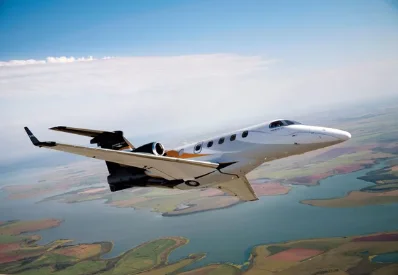
Embraer Phenom 100
The Phenom 100 is a twin-engine business jet in the Very Light Jet or Personal Jet category. It is produced by the manufacturer Embraer at its headquarters in Brazil and in the USA. The internal type designation of the jet is EMB-500, although it is marketed exclusively as the Phenom 100. The jet made its maiden flight on 26 July 2007 in São José dos Campos, Brazil. The first customer delivery was in December 2008 to a couple from Texas.
Very Light Jet
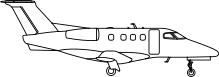
| Specification | Value |
|---|---|
| Manufacturer | Embraer |
| Category | Very Light Jet |
| Range* | 2182 km 1178 NM |
| Cruise speed | 722 km/h 390 kts |
| Seats** | 4 |
| Suitcases | 4 |


* with IFR reserves
** in standard configuration
Aircraft Pictures


History
Upgraded versions are marketed as the Phenom 100E and 100EV. The Phenom 100 is considered one of the fastest jets in its category with similarly low operating costs to a turboprop. The Phenom 100 is also popular in pilot training for passenger airlines: it is used by the Mexican business jet operator Across, as well as by the Arab airlines Emirates and Etihad.
The most common cabin configuration for the Embraer Phenom 100 has space for 4 suitcases and 4 carry on bags. The bottom line is that the Phenom 100 offers first-class comfort and outstanding performance at low operating costs. Last but not least, the high degree of automation makes the Phenom 100 a valued single-pilot jet, which was already described by industry experts as a "computer with wings" when it was launched. For years, it has rightly been considered one of the best jets in its class. It should come as no surprise, however, that this successful aircraft is Embraer's first business jet to be developed from scratch.
Embraer's experience as a commercial aircraft manufacturer is on full display with the Phenom - especially in terms of maintenance philosophy. This approach and continuous improvements have led to high customer loyalty.
When it comes to prestigious awards, the Phenom jets don't have to hide from the competition either. Among the numerous design awards are the IDEA/Brazil Design Award (2008), the German IF Awards for best product and best interior (2006, 2007) and the Chinese Good Design Award for best design (2006). In May 2008, the editors of the US luxury magazine Robb Report voted the Phenom 100 the "Best of the Best" business jet.
Technical Specifications
General information
| Model name | Phenom 100 |
|---|---|
| Manufacturer | Embraer |
| Aircraft category | very light jet |
| ICAO Designator | E50P |
| Start/End of Production | 2008 - Still in production |
| Number of pilot(s) | 1-2 |
Performances
| Range (with IFR reserves) | 1178 NM (2182 km) |
|---|---|
| Ferry range | 1320 NM (2445 km) |
| Cruise speed | 390 kts (722 km/h) |
| Max Operating Speed – VMO | 280 KIAS |
| Max Mach Operating Speed - MMO | Mach 0.7 |
| Long-Range Cruise Speed - LRC | 333 KTAS |
| Approach Speed | 100 kts |
| Takeoff Distance | 953 m |
| Average Landing Distance | 741 m |
| Service Ceiling | 41000 ft |
| Thrust | 1695 lbf |
Aircraft technology
| Engine type | Turbofan |
|---|---|
| Engine(s) | 2 x Pratt & Whitney PW617F |
| Avionics | Embraer Prodigy (Garmin G1000/G3000) |
Dimensions and capacity
| Aircraft length | 12.82 m |
|---|---|
| Aircraft height | 4.35 m |
| Wing span | 12.3 m |
| Cabin height | 1.5 m (4.92 ft) |
| Cabin length | 3.35 m (11 ft) |
| Cabin width | 1.55 m (5.08 ft) |
| Baggage volume | 1.56 m3 |
| Seats (standard config) | 4 |
| Seats (max) | 7 |
| Suitcases | 4 |
| Carry-on luggage | 4 |
| Maximum payload | 595 kg |
| Maximum TakeOff Weight - MTOW | 4800 kg |
| Maximum Landing Weight - MLW | 4430 kg |
Advantages & Disadvantages
Advantages of an Embraer Phenom 100 as a rental aircraft
High cruising speed on short routes: The Phenom 100 combines the performance of a jet with the ergonomics of a turboprop. As a result, it exceeds expectations of the potential performance of an entry-level jet. In the words of one customer: "With the Phenom 100, we reach our destination in significantly less time than with the turboprop it replaces."
Low operating costs: The low weight, the use of the latest computer technologies and the single-pilot operation are three reasons for the comparatively low operating costs of the jet. The lower weight reduces fuel consumption and saves costs and the environment in equal measure. By using software instead of hardware, there is less wear and tear. Finally, single-pilot operation saves on the salary of the co-pilot.
Wide cabin: The Phenom 100 has a large cabin cross-section and offers more head and legroom than many competitors. Depending on the configuration, there is room for 4 to 6 passengers in the cabin without feeling cramped. The large windows give the cabin a light and bright feel-good ambience.
Storage options: Depending on the configuration, either a fifth seat or a spacious wardrobe is available in the cabin. The luggage compartment is located in the rear of the jet and can be conveniently accessed from the outside via a generous cargo door. The 1.5 cubic metre volume offers enough space for four golf bags, four pieces of hand luggage and four laptop bags. A separate baggage area in the front is available for the crew.
State-of-the-art computer control: Both the Phenom 100 and its big brother, the Phenom 300, are highly computer-controlled aircraft. They are equipped with countless sensors, processors and diagnostic functions. This makes the flight safer, simplifies maintenance and reduces the workload in the cockpit.
Disadvantages of an Embraer Phenom 100 as a rental aircraft
Range only for short distances: With a maximum range of 2,182 kilometres, the agile jet is only suitable for short flights. The Phenom 100 masters most inner-European destinations with flying colours, but for more distant destinations it is necessary to use larger private jets.
Limited passenger capacity: Originally designed as an efficient air taxi, the smallest Embraer shows its comfort advantages especially with few passengers. Although the small Phenom offers up to six seats in the cabin without a wardrobe and lavatory, those who value a high level of comfort will find it difficult to find a place to sleep. However, those who value a high level of comfort should opt for more spacious alternatives if there are more than four passengers.
FAQ
How much does an Embraer Phenom 100 cost?
Used Embraer Phenom 100s start at around 1.9 million US dollars. The list price of the latest variant 100EV is 4.6 million US dollars.
How does the Phenom 100 differ from the Honda Jet?
Both the Phenom 100 and the Honda Jet are excellent aircraft in the young Very Light or Personal Jet segment. Both offer space for up to 5 passengers in the most common configuration and are certified for single-pilot operation. In terms of taxiin volume, the Honda Jet is slightly ahead. In terms of acquisition costs, however, the Phenom 100 scores: with its price of 4.6 million USD, it is about 400,000 USD cheaper than the 5 million USD Honda Jet. The Honda Jet is a little faster, but in direct comparison it has to give up a few kilometres of range.
Who owns an Embraer Phenom 100?
Due to its comparatively low price, the Phenom 100 is not as prestigious as more expensive luxury jets. It is known that the Brazilian football star Neymar owns, among others, a Phenom 100 and uses it for short-haul flights.
Which airports can be served by a Phenom 100?
The Phenom 100 belongs to the category of Very Light Jets and can be used for short-haul flights of up to about 2,000 kilometres (about two and a half hours). Its high performance coupled with its manoeuvrability allow it to fly to smaller and hard-to-reach airports. The aircraft requires a paved runway for take-off and landing, but can land at most regional airports in Europe.
How many Phenom 100s have been sold so far?
Since 2008, 386 Embraer Phenom 100/EV Very Light Jets have been delivered. The top year was 2010, when exactly 100 aircraft were delivered. Compared to the other models from Embraer, the Phenom 100 ranks second behind the Embraer Phenom 300/E.
Is the Phenom 100 faster than the HondaJet HA 420?
The HondaJet HA 420 cruises at approximately 782 km/h (422 knots), making it slightly faster than the Phenom 100's 722 km/h (390 knots). However, the difference is marginal at roughly 30 km/h, meaning both aircraft offer comparable performance for regional business travel.
How many passengers can the Phenom 100 accommodate?
The Phenom 100 typically seats 4 passengers in its standard configuration, though it can accommodate up to 7 passengers in a high-density layout. The cabin measures 3.35 metres in length, 1.55 metres in width, and 1.50 metres in height, providing comfortable space for business travellers. The aircraft also offers storage for 4 carry-on bags and 4 suitcases.
What is the cruising speed of the Phenom 100?
The Embraer Phenom 100 cruises at 722 km/h (390 knots), making it one of the faster aircraft in the Very Light Jet category. This speed allows efficient regional travel, with journeys such as London to Paris taking approximately one hour, or Frankfurt to Rome in just over two hours.
What is the maximum range of the Phenom 100, and which city pairs can it connect?
The Phenom 100 has a maximum range of 2,182 km (1,178 nautical miles), positioning it well for regional European flights. This range comfortably accommodates routes such as London to Barcelona, Paris to Berlin, or Madrid to Rome without requiring fuel stops, making it ideal for business travel within Europe.
What makes the Phenom 100 suitable for single-pilot operation?
The Phenom 100 features advanced computer-controlled systems and automated functions that enable certified single-pilot operation, reducing operational costs significantly. The aircraft incorporates numerous sensors, processors, and diagnostic functions that simplify cockpit workload and enhance flight safety. This automation, combined with its Pratt & Whitney PW617F1-E engines, makes it an economical choice for owner-operators whilst maintaining the performance standards of larger business jets.