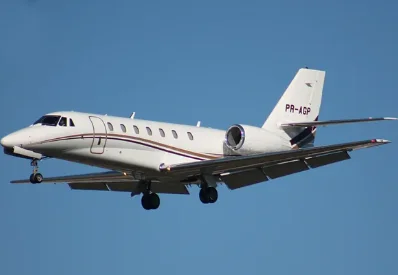
Cessna Citation CJ1
The CitationJet/CJ1 jets are a series of light business jets. The twin-engine low-wing aircraft are built by U.S. manufacturer Cessna, which has been part of the Textron Group since 1992. The Model 525 was first introduced in October 1989. The six-seater made its maiden flight on April 29, 1991, and was certified by the Federal Aviation Administration (FAA) on October 16, 1992. The first customer delivery took place in March 1993.
Light jet
| Specification | Value |
|---|---|
| Manufacturer | Cessna |
| Category | Light jet |
| Range* | 2076 km 1121 NM |
| Cruise speed | 698 km/h 377 kts |
| Seats** | 5 |
| Suitcases | 3 |


* with IFR reserves
** in standard configuration
Aircraft Pictures


History

The original 525 CitationJet model was developed as a replacement for the discontinued Citation I. This was preceded by price increases for the Pratt & Whitney engines, which meant that the jet could no longer be offered at a competitive price. In many ways, the CitationJet was an entirely new aircraft: it used a modified version of the forward fuselage, optimised laminar-flow wings and a new T-tail. To reduce its drag, a cowling wrapped part of the wing and the engines were mounted higher up on the tail. Composite materials were used to save weight on non-load-bearing components, such as the fairing and the nose of the aircraft. The CitationJet's fuselage is 27 centimetres shorter than that of the Citation I, and the lowered centre aisle allowed the cabin height to be increased.
The aircraft, which weighs around 4,500 kilograms, is powered by newly developed Williams FJ44 engines, which were later also used in light jets from other manufacturers, such as the PC-24 from Pilatus. The advanced Electronic Flight Instrument System (EFIS) avionics relieve the pilot's workload when flying and provide greater safety for all passengers through intelligent traffic collision avoidance systems. The Cessna CitationJet has a single-pilot certificate. The Cessna Citation CJ1 (also Model 525) represents a further development of the original CitationJet. In addition to the avionics system, the maximum take-off weight of the still comparatively light private jet has also been improved.
The CitationJet series from Cessna is used primarily for domestic flights or short trips to neighbouring countries because of its suitability for short distances. Transatlantic flights are possible with stopovers, but rather uncommon. For longer flights, there are more comfortable and faster alternatives. A comparatively short runway is sufficient for the popular light aircraft. Therefore, passengers can also travel in a CitationJet from us to smaller airports.
By June 2017, 2,000 units of all CitationJet variants had been delivered. In total, the series has already clocked up an impressive 5 million flight hours.
The Cessna CitationJet is one of the most popular private jets in the world. Therefore, it is not surprising that famous personalities such as the US racing driver Jeff Burton, the English model Cara Delevingne, the French DJ David Guetta and the acting legend Harrison Ford also own one of the popular specimens.
More than 30 years have passed since the CitationJet Model 525 first took off on 29 April 1991. Compared to its predecessor, it featured improved avionics and a more efficient wing design. Also, thanks to its two brand-new Williams FJ44-1A turbofan engines, it offered an advanced blend of performance, efficiency and passenger comfort. And all this in a jet aircraft that was easy to operate by a single pilot.
These features have been maintained in subsequent CJ variants certified since the original CitationJet and further developed in the face of increased competition. To date, Cessna has delivered more than 2,000 Type 525 models, representing more than one-third of the manufacturer's total Citation model line. According to industry reports, Cessna's CJ jets are the best-selling light jet series in private aviation.
Today, the 525 model lives on in the current M2 Gen2, CJ3+ and Citation CJ4 Gen2 series. While these newer variants attract the most attention today, the original CitationJet remains an extremely attractive choice. Whether it's for businesspeople looking for a reliable private aircraft to charter or a low-cost entry into the light jet segment with a high self-flying ownership percentage.
Technical Specifications
General information
| Model name | Citation CJ1 |
|---|---|
| Manufacturer | Cessna |
| Aircraft category | light jet |
| ICAO Designator | C525 |
| Start/End of Production | 2000 - 2005 |
| Number of pilot(s) | 1-2 |
Performances
| Range (with IFR reserves) | 1121 NM (2076 km) |
|---|---|
| Ferry range | 1290 NM (2389 km) |
| Cruise speed | 377 kts (698 km/h) |
| Max Operating Speed – VMO | 263 KIAS |
| Max Mach Operating Speed - MMO | Mach 0.7 |
| Long-Range Cruise Speed - LRC | 329 KTAS |
| Approach Speed | 109 kts |
| Takeoff Distance | 939 m |
| Average Landing Distance | 758 m |
| Rate of Climb | 3250 ft/min |
| Service Ceiling | 41000 ft |
| Thrust | 1900 lbf |
Aircraft technology
| Engine type | Turbofan |
|---|---|
| Engine(s) | 2 x Williams FJ44-1A |
| Avionics | Rockwell Collins Pro Line 21 |
Dimensions and capacity
| Aircraft length | 13 m |
|---|---|
| Aircraft height | 4.2 m |
| Wing span | 14.3 m |
| Cabin height | 1.46 m (4.8 ft) |
| Cabin length | 3.35 m (11.0 ft) |
| Cabin width | 1.46 m (4.8 ft) |
| Baggage volume | 1.56 m3 |
| Seats (standard config) | 5 |
| Seats (max) | 7 |
| Suitcases | 3 |
| Carry-on luggage | 4 |
| Maximum payload | 694 kg |
| Maximum TakeOff Weight - MTOW | 4808 kg |
| Fuel capacity | 1811 L |
Advantages & Disadvantages
Advantages of a Cessna CitationJet (525) / CJ1 as a rental aircraft:

- First class availability: One advantage of the Cessna CitationJet as a charter aircraft is its availability. Since it is one of the most popular light business aircraft in the world, there is usually a good deal on charter flights. This can be especially important when travelling at short notice.
- Short-range champion: With a range of up to 2,750 kilometers, it is optimally designed for shorter distances. Its lightweight and aerodynamic design allows it to consume less fuel than larger jets. The CitationJet is particularly suitable for intra-European flights.
- Best-selling light jet: The CitationJet is the best-selling light business jet because it is affordable, reliable and efficient. It also offers excellent value for private jet charter flights, making it a popular choice for business and leisure travellers alike.
- Low operating costs: The light jet's low operating costs make the 525 an advantageous choice for many private jet charter flights. Its FJ44 engines are particularly fuel-efficient, and the long availability of the CitationJet family means it is a particularly technically mature aircraft.
- Proven design: The CitationJet is a popular private jet for charter flights due to its proven design. The business jet has been in production since 1993 and has a long track record of reliability and safety. The long production history also means that it has been refined and updated over time and is considered an extremely proven aircraft, not least because of this.
Disadvantages of a Cessna CitationJet (525) / CJ1 as a rental aircraft:
- Range Limitation: The CitationJet has a limited range and cannot fly as far as other private jets in its class. This could be a disadvantage for private jet charter flights to more distant destinations, as a stopover would have to be scheduled when travelling in the Cessna Jet. Passengers travel about 500 kilometers further in the newer CJ2+, for example.
- Limited comfort: The CitationJet aircraft family is equipped with limited comfort features. Compared to larger, more luxurious business jets, the small Cessna Jet takes a back seat when it comes to using travel time for meetings, focused work or relaxation. The cabin is compact, but can feel a bit cramped when fully occupied. In addition, storage space is limited.
Where the Cessna Citation CJ1 flies most
Geneva to Paris is the busiest Cessna CitationJet and CJ1 route in Europe, with 120 flights in 2025. London leads the ranking with 1,039 movements, ahead of Paris (842) and Geneva (744).
The CJ1 is a short-range jet. Half of its flights in the region covered less than 490 km, and 37% of its charter flights worldwide touched the region. Several smaller markets rely on it. In Belgrade, it flew 7.5% of all charter movements, mostly to Tivat, Ljubljana and Athens. Antwerp owes its 7th place to frequent links with Hamburg (73 flights) and Milan (47).
On the Riviera, Nice and Cannes recorded half or more of their CJ1 movements between June and September. Sion, the gateway to the Valais ski resorts, completes the top 10.
Based on LunaJets analysis of ADS-B flight tracking data. Contains information from adsb.lol, made available under the Open Database License (ODbL). The figures cover take-offs and landings on commercial charter flights (Part 135 / CAT) in 2025, in Europe, the Middle East and North Africa. They include every version that shares the aircraft's type code, and a city needs at least 20 movements to be ranked.
Top Cities in 2025
For a short business trip, the Geneva page covers the busiest light-jet route from Geneva, to Paris. Private flights from Antwerp are another regular CJ1 trip, often to Hamburg and Milan.
FAQ
Which airports can be served with a CitationJet (525)/CJ1?
Designed to operate at airports with short runways, the Citation CJ1 is the perfect choice for those who shy away from the cost and time of ground transportation. The CitationJet is one of the few private business jets certified to operate at London City Airport. It can also easily fly to other small airports in Central Europe, including Lugano and St. Moritz airports in Switzerland and Nice Airport on the Côte d'Azur.
How many Cessna CitationJet (525)/CJ1 have been sold so far?
A total of 443 units of the series were sold between 1996 and 2005. No independent data is available on the production period from 1993 to 1995. With 64 units delivered, 1998 was the most successful year for American aircraft manufacturers. This sales success has only been surpassed once within the CJ series, by the CJ3 in 2008, with 88 aircraft sold.
How much does a Cessna CitationJet cost?
Neither the original CitationJet nor the CJ1 are still in production. Anyone interested in purchasing one of these jets must therefore look for a used model. A Cessna CitationJet business jet in acceptable condition costs between $1 million and $1.4 million. However, depending on the age and condition of the aircraft, buyers may be able to acquire a used example for much less. These factors, however, will affect the remaining useful life of the jet. The older the aircraft and the more it has been used, the more budget must be budgeted for maintenance. On average, private jets have a service life of up to 25 years and around 12,000 flight hours.
Is the Cessna CitationJet (525)/CJ1 certified for single-pilot operation?
The Cessna CitationJet (525)/CJ1 Jet is certified for single-pilot flight. Optionally, however, a co-pilot can also fly in the cockpit.
How does the Cessna Citation CJ1 differ from the Cessna Citation CJ2?
The CJ2 is a slightly larger and faster version of its smaller brother, the CJ1. The taxiin is 84 centimetres longer and the wingspan is almost 89 centimetres larger. Thanks to more modern engines, the CJ2 has a higher cruising speed and is more efficient than the CJ1. The taxiin seats six passengers - one more than in the CJ1.
Does the Cessna CitationJet have an on-board toilet?
Yes, the Citationjet has a toilet. It is not completely separated, but can be used in exceptional situations.
What is the range of the Citation CJ1?
The Citation CJ1 has an NBAA IFR range of 2,087 km (1,127 nm), depending on payload, weather, and routing. This permits nonstop flights such as Paris to Geneva, London to Milan, or Munich to Brussels.
Can the Citation CJ1 use smaller airports?
Yes. The Citation CJ1 is a light jet with short-field capability, enabling it to operate from regional airports that larger aircraft cannot. This provides access to destinations closer to resorts or business districts. The Cessna Citation CJ1, along with its variant the CJ1+, is also certified for operations at London City Airport, which requires specific approval due to its steep approach path.
How does the Citation CJ1 compare to the Citation Mustang?
The Citation CJ1 is larger than the Citation Mustang, seating 5 passengers (standard configuration) versus 4 in the Mustang. In terms of range, the Mustang flies slightly farther, with an NBAA IFR range of 2,161 km (1,167 nm) compared to the CJ1’s 2,087 km (1,127 nm). The Mustang is generally the more economical charter option, while the CJ1 costs a bit more but provides extra cabin space and payload capacity, making it preferable when comfort or baggage allowance is a priority.
How does the Citation CJ1 compare to the Citation CJ2?
The Citation CJ2, introduced after the CJ1, has a longer NBAA IFR range of 2,463 km (1,330 nm) compared to the CJ1’s 2,087 km (1,127 nm), as well as a larger cabin. The CJ1 seats 5 passengers (standard configuration), while the CJ2 seats 6 passengers (standard configuration). Both aircraft maintain single-pilot certification, but the CJ2 provides more comfort and scope for longer European routes, making it preferable for larger groups or extended itineraries.