


Pilatus PC-24
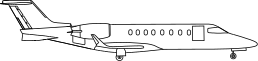
The off-road capability and versatility of a Pilatus turboprop combined with the speed and luxury features of a light jet make the first Swiss business jet in a class of its own: with the twin-engined Pilatus PC-24 you rent a fast, versatile and spacious private aircraft.
Super light jet
| Specification | Value |
|---|---|
| Manufacturer | Pilatus |
| Category | Super light jet |
| Range* | 3704 km 2000 NM |
| Cruise speed | 815 km/h 440 kts |
| Seats** | 6-8 |
| Suitcases | 6 |


* with IFR reserves
** in standard configuration
Aircraft Pictures


History
With the diverse PC-24, Pilatus has succeeded in convincing the industry that its super light jet range offers passengers a perfect balance between performance and comfort. In doing so, the Swiss are focusing on innovation, but also rely on proven technology. The success of the PC-24 Twin Jet is clearly demonstrated by the demand at the launch: after only 36 hours, the order books were full.
Technical Specifications
General information
| Model name | PC-24 |
|---|---|
| Manufacturer | Pilatus Aircraft |
| Aircraft category | super light jet |
| ICAO Designator | PC24 |
| Start/End of Production | 2018 - Still in production |
| Number of pilot(s) | 1-2 |
Performances
| Range (with IFR reserves) | 2000 NM (3704 km) |
|---|---|
| Ferry range | 2123 NM (3932 km) |
| Cruise speed | 440 kts (815 km/h) |
| Max Operating Speed – VMO | 290 KIAS |
| Max Mach Operating Speed - MMO | Mach 0.74 |
| Long-Range Cruise Speed - LRC | 372 KTAS |
| Approach Speed | 98 kts |
| Takeoff Distance | 942 m |
| Average Landing Distance | 734 m |
| Rate of Climb | 3960 ft/min |
| Service Ceiling | 45000 ft |
| Thrust | 3420 lbf |
Aircraft technology
| Engine type | Turbofan |
|---|---|
| Engine(s) | 2 x Williams FJ44-4A |
| Avionics | Pilatus ACE (Honeywell Primus Epic 2.0) |
Dimensions and capacity
| Aircraft length | 16.8 m |
|---|---|
| Aircraft height | 5.3 m |
| Wing span | 17 m |
| Cabin height | 1.55 m (5.1 ft) |
| Cabin length | 7.01 m (23.0 ft) |
| Cabin width | 1.69 m (5.6 ft) |
| Baggage volume | 2.5 m3 |
| Seats (standard config) | 6-8 |
| Seats (max) | 10-12 |
| Suitcases | 6 |
| Carry-on luggage | 3 |
| Maximum payload | 1406 kg |
| Maximum TakeOff Weight - MTOW | 8500 kg |
| Maximum Landing Weight - MLW | 7865 kg |
| Fuel capacity | 3362 L |
Advantages & Disadvantages
Advantages of a Pilatus PC-24 as a rental aircraft:
- Powerfully modern: Thanks to its two Williams FJ44 turbofans, the Pilatus business jet has significantly more power than its smaller but older turboprop brother, the PC-12. It flies at a top speed of up to 815 km/h and takes travellers to more distant destinations faster. Pilatus Flugzeugwerke is thus fulfilling the desire of countless turboprop customers for greater speed and range.
- Safe: Like all Pilatus aircraft, the PC-24 can take off with just one pilot. The "single-pilot certification" is taken into account by using the latest avionics technology. Automation is intended to relieve the pilots and thus increase safety. The ACE avionics package tailored to Honeywell Aerospace's PC-24 is also equipped with the most advanced safety features.
- Diverse: The seats of the PC-24 can be easily removed and the cargo compartment divider can be moved flexibly. This allows the configuration of the aircraft cabin to be optimally adapted to the individual needs of the passengers. This is supported by the consistently flat cabin floor, which offers passengers a pleasant and voluminous ambience.
- Off-road capability: The PC-24 is the only business jet in the world that can land on unpaved runways. The certification of the European Union Aviation Safety Agency (EASA) covers sand, gravel, grass and snow runways. In addition, a shorter runway than the competition is sufficient for Pilatus, giving travellers access to many small airfields.
- Spacious: The PC-24 succeeds in combining the performance of a light jet with the cabin size of a medium-light jet. It also offers generous head and legroom for tall passengers. It can even be loaded with a forklift truck via a pallet-sized separate cargo door as standard. The internal luggage compartment is pressurised and is accessible from the cabin during the flight.
Disadvantages of a Pilatus PC-24 as a rental aircraft:
- Availability: Compared to competing aircraft, the PC-24 is still relatively young. According to the manufacturer, only 75 aircraft had been delivered worldwide by the end of fiscal year 2019. Depending on the point of departure, supply bottlenecks may therefore still occur at present.
- Short-haul efficiency: A business jet like the PC-24 can only show its high maximum airspeed on longer routes. On routes under 600 kilometres, the travel time is comparable to turboprops. As a jet-powered private jet, however, it requires roughly twice as much fuel, which can also have an impact on the rental price.
Where the Pilatus PC-24 flies most
The Pilatus PC-24 is mostly flown in this region: 69% of its commercial charter flights worldwide started or ended in Europe, the Middle East or North Africa in 2025. London leads with 1,880 movements, ahead of Paris (990) and Zurich (931).
Antwerp is where the PC-24 matters most. It flew 19% of all charter movements there, with frequent flights to Prague, London, Cannes and Mnichovo Hradiště, a small airfield in the Czech Republic. In Madrid, its busiest link was Santander (55 flights), on the north coast of Spain.
The PC-24 is used for short trips: 43% of its flights in the region covered less than 500 km. London to Paris (119 flights) was its busiest route between two cities in the list. Ibiza recorded 68% of its movements between June and September.
Based on LunaJets analysis of ADS-B flight tracking data. Contains information from adsb.lol, made available under the Open Database License (ODbL). The figures cover take-offs and landings on commercial charter flights (Part 135 / CAT) in 2025, in Europe, the Middle East and North Africa. They include every version that shares the aircraft's type code, and a city needs at least 20 movements to be ranked.
Top Cities in 2025
For short business trips, the Antwerp page covers prices and airports. In Spain, flights from Madrid often go to Santander on the north coast.
FAQ
How much does a Pilatus Jet PC-24 cost?
At the launch in May 2014, the first production series of the Pilatus Business Jet was offered starting at a price of 8,900,000 US dollars. After the first 84 aircraft were sold within 36, Pilatus initially closed the order books. Since May 2019, orders have been possible at a new base price starting at €9,000,000. The PC-24 with its upscale equipment now costs €9,500,000. The manufacturer justified the price increase with the higher than expected development costs of over 500 million Swiss francs.
Which airports can be served with the PC-24?
Due to its special features and corresponding certifications, the PC-24 can serve a larger number of smaller and remote airports. Here is a selection of possible departure and destination airports:
- Lugano Airport (LUG): Swiss regional airport 4 kilometres west of Lugano. The airport is also known as Lugano-Agno Airport.
- La Môle - Saint-Tropez Airport (LTT): French airport in La Môle, 15 kilometres southwest of St Tropez. Despite its only 4,500 inhabitants, this small town on the French Riviera is one of the most famous travel destinations on the Côte d'Azur. Today, St Tropez is especially popular for its beaches and its extravagant nightlife.
- Le Castellet Airport (CTT): French airport 5 kilometres north of the community of Le Castellet, not far from the Circuit Paul Ricard motorsport race track.
- London City Airport (LCY): The most central airport of the English metropolis is only 10 kilometres from the city centre.
- La Perdiz Airport (LEIZ): Small Spanish private airport surrounded by natural landscape, about 250 kilometres south of Madrid.
- Portimão Airport (PRM): Small Portuguese airport in Montes de Alvor in the Algarve.
- Brac Airport (BWK): One of three airports on the Croatian island. It is also known as Bol Airport because of its proximity to the seaside resort and holiday resort of Bol.
- Spa-La Sauvenière Airport (EBSP): Belgian airport in Spa, only 6 kilometres away from the Formula 1 race track Circuit de Spa-Francorchamps.
How does the Pilatus PC-24 differ from the LearJet 75?
The PC-24 has an approximately 10% higher purchase price but significantly lower direct operating costs than the LearJet 75 Liberty. Two weighty arguments for potential buyers. For tenants, the operating costs are often reflected in a lower charter price for the PC-24. This thesis is also underlined by the fact that the LearJet 75 Liberty, unlike the PC-24, can only take off with two pilots in the cockpit. If speed or range are important criteria, the LearJet performs slightly better. On the other hand, the PC-24 scores plus points when transporting bulky and heavy luggage due to the additional cargo door and the higher payload. If small airports or airfields are to be approached, the PC-24 "Super Versatile Jet" is practically without alternative due to its suitability for short runways and natural tracks.
How many pilots fly the PC-24?
The Pilatus aircraft have a so-called single-pilot certification. A key criterion for the award is whether the workload involved in flying the aircraft is appropriate for a pilot. The modern cockpit equipment of the PC-24 makes this possible. Of course, the first Pilatus Jet is also equipped with a co-pilot seat. Multi-pilot operation is thus possible at any time.
How does the PC-24 compare to the Cessna Citation CJ4?
The PC-24 and Citation CJ4 represent compelling alternatives in the light jet market, each with distinct advantages. The PC-24 offers superior cabin volume at 14.2 cubic metres compared to the CJ4's 8.8 cubic metres, whilst the CJ4 provides slightly shorter range at 3,509 km versus the PC-24's 3,706 km (2,000 nautical miles). Speed-wise, the CJ4 edges ahead with 819 km/h (442 knots) cruise speed compared to the PC-24's 815 km/h (440 knots). However, the PC-24 requires significantly shorter runways at 820 to 893 metres takeoff distance (depending on the load) versus the CJ4's 1,009 metres, providing access to smaller airports.
How far can the PC-24 fly without refuelling?
The PC-24 offers an NBAA IFR range of 3,704 km (2,000 nautical miles) with a standard six-passenger executive configuration, whilst the ferry range extends to 3,932 km (2,123 nautical miles) when carrying no payload. This substantial range capability enables non-stop flights from London to Istanbul or New York to Dallas, positioning the PC-24 as an exceptional choice for intercontinental business travel. With a 544-kilogram payload, the range reduces to approximately 3,706 km (2,000 nautical miles), still providing remarkable flexibility for executive transport missions.
How many passengers can the PC-24 accommodate?
The PC-24 can carry up to 12 passengers in high-density configuration, though it typically seats six to eight passengers in executive layout. The aircraft features a remarkably spacious cabin with 14.2 cubic metres of interior volume, providing generous headroom and comfort that exceeds many aircraft in its class. The cabin includes a pressurised cargo compartment with 2.5 cubic metres of storage capacity, accessible from both inside the cabin and externally, offering exceptional luggage flexibility for passengers.
What is the maximum cruise speed of the PC-24?
The PC-24 achieves a maximum cruise speed of 815 km/h (441 knots typical cruise speed) at cruising altitude. This impressive speed places the PC-24 competitively within the light jet category, allowing passengers to reach destinations efficiently whilst maintaining the aircraft's renowned versatility. The aircraft cruises comfortably at Mach 0.74, delivering swift travel times that rival traditional business jets in its class.
What makes the PC-24 unique regarding runway operations?
The PC-24 stands as the only business jet certified to operate on unpaved runways, including grass, gravel, sand, and snow surfaces. This exceptional capability, inherited from Pilatus's extensive experience with the PC-12 turboprop, opens access to approximately 21,000 additional airports worldwide compared to conventional business jets. The aircraft's robust landing gear features long-stroke design and specialized wing flaps that protect engines from debris, enabling operations in remote locations where traditional jets cannot venture. Additionally, the PC-24 incorporates a standard cargo door—unique in its class—allowing forklift loading and rapid reconfiguration between passenger and cargo operations.


