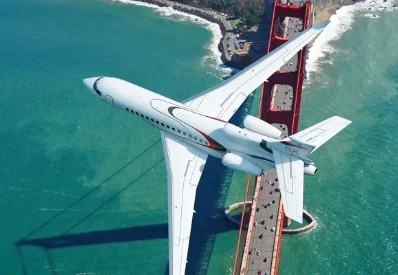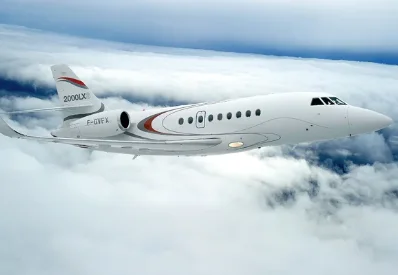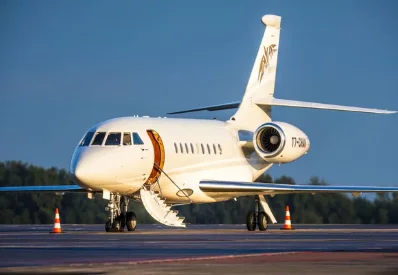
Dassault Falcon 2000S
The Falcon 2000S is very similar to its sister aircraft, the Falcon 2000LX, as it is built around the same design and structure but, due to its reduced range and other factors, it belongs to the category of Super Midsize Jets. Like the LX, the 2000S offers a spacious, stand-up cabin, comfortably accommodating up to 10 passengers in a Club 4 arrangement and 6 individual seats. The main difference between them is the exceptional low-speed performance of the 2000S, which is responsible for it having the greenest footprint of Dassault's entire Falcon series. This low-speed performance also reduces the 2000S' landing distance to 705 metres, meaning that this jet has access to 50% more airfields than other aircraft in its class, enabling it to get you to more remote landing strips that are often closer to your final destination.
Large jet
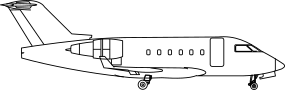
| Specification | Value |
|---|---|
| Manufacturer | Dassault |
| Category | Large jet |
| Range* | 6204 km 3350 NM |
| Cruise speed | 893 km/h 482 kts |
| Seats** | 10 |
| Suitcases | 12 |


* with IFR reserves
** in standard configuration
Aircraft Pictures


History
Dassault announced the Falcon 2000S on May 16, 2011, as a specialized variant of the Falcon 2000 family designed for enhanced short-field performance. The aircraft addressed specific operational requirements for airports with challenging runway conditions.
Development focused on improving the aircraft's ability to operate from shorter runways, with testing beginning in 2011. The 2000S incorporated short-field characteristics that distinguished it from other variants in the Falcon 2000 lineup.
The aircraft received EASA certification on March 19, 2013, validating its enhanced airport performance capabilities. First deliveries commenced in 2013, providing operators with access to airports previously unavailable to conventional long-range business jets.
The 2000S featured specialized systems and design modifications that allowed operations from shorter runways while maintaining the Falcon 2000's renowned range and cabin comfort. The aircraft filled a unique niche in the business aviation market, offering the combination of short-field capability with intercontinental range that few other aircraft could match.
Technical Specifications
General information
| Model name | Falcon 2000S |
|---|---|
| Manufacturer | Dassault Aviation |
| Aircraft category | large jet |
| ICAO Designator | F2TH |
| Start/End of Production | 2013 - 2021 |
| Number of pilot(s) | 2 |
Performances
| Range (with IFR reserves) | 3350 NM (6204 km) |
|---|---|
| Ferry range | 3589 NM (6647 km) |
| Cruise speed | 482 kts (893 km/h) |
| Max Operating Speed – VMO | 370 KIAS |
| Max Mach Operating Speed - MMO | Mach 0.86 |
| Long-Range Cruise Speed - LRC | 441 KTAS |
| Approach Speed | 108 kts |
| Takeoff Distance | 1318 m |
| Average Landing Distance | 705 m |
| Rate of Climb | 3700 ft/min |
| Service Ceiling | 47000 ft |
| Thrust | 7000 lbf |
Aircraft technology
| Engine type | Turbofan |
|---|---|
| Engine(s) | 2 x Pratt & Whitney PW308C |
| Avionics | EASy II / Pro Line 4 |
Dimensions and capacity
| Aircraft length | 20.23 m |
|---|---|
| Aircraft height | 7.11 m |
| Wing span | 21.38 m |
| Cabin height | 1.88 m (6.2 ft) |
| Cabin length | 8.0 m (26.33 ft) |
| Cabin width | 2.34 m (7.7 ft) |
| Baggage volume | 3.7 m3 |
| Seats (standard config) | 10 |
| Seats (max) | 19 |
| Suitcases | 12 |
| Carry-on luggage | 10 |
| Maximum TakeOff Weight - MTOW | 19414 kg |
| Maximum Landing Weight - MLW | 17826 kg |
| Fuel capacity | 6622 L |
FAQ
Can the Falcon 2000S use smaller airports?
Yes. The Falcon 2000S was designed with improved aerodynamics and landing performance compared to earlier 2000 models. It can operate from shorter runways, opening access to airports closer to city centres or resort areas. The Dassault Falcon 2000S is also certified for steep approaches and approved to operate at London City Airport (LCY), meeting the requirements for its demanding 5.5-degree glideslope.
How does the Falcon 2000S compare to the Challenger 350?
The Falcon 2000S has an NBAA IFR range of 6,204 km (3,350 nm) and carries 8–10 passengers in a wide-body cabin. The Challenger 350 is a super-midsize jet with a shorter NBAA IFR range of 5,926 km (3,200 nm), typically seating 8 passengers. In terms of performance, the Falcon 2000S requires about 1,318 m (4,325 ft) of runway for takeoff and 701 m (2,300 ft) for landing, while the Challenger 350 needs around 1,472 m (4,829 ft) for takeoff and 702 m (2,302 ft) for landing. The Falcon 2000S also offers a wider cabin at 2.34 m (7.8 ft), compared with 2.19 m (7.2 ft) for the Challenger 350, giving it more shoulder room and a roomier feel.
How far can the Falcon 2000S fly on a charter flight?
The Falcon 2000S has an NBAA IFR range of 6,204 km (3,350 nm). This allows nonstop flights such as London to Dubai or Paris to Lagos. While it does not reach as far as the 2000LX or LXS, it provides more than enough range for most intercontinental and regional business missions.
Where does the Falcon 2000S fit within the Falcon 2000 family?
Launched in 2011, the Falcon 2000S was introduced as the entry-level wide-cabin jet in the 2000 family. It offered a reduced NBAA IFR range of 6,204 km (3,350 nm) compared with the 2000LX, but gained improved runway performance for shorter fields. This made the 2000S attractive for clients wanting the comfort of a large-cabin Falcon while focusing on shorter intercontinental or high-demand regional missions.