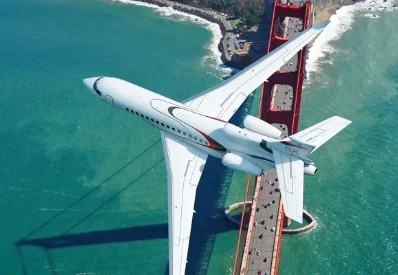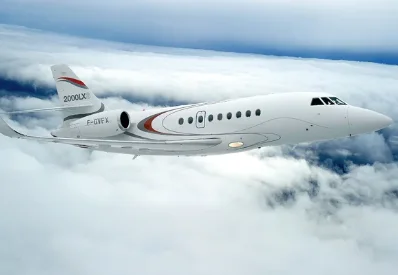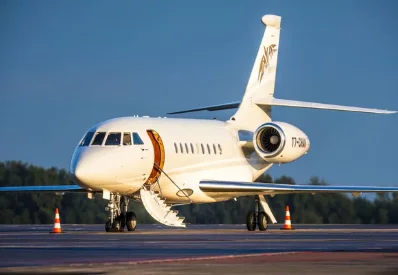
Dassault Falcon 2000
The Falcon 2000 was certified in 1994 as the original version of the Falcon 2000 range of Large Jets. French manufacturer Dassault developed the aircraft to be a smaller, twin-engine alternative to their vastly successful Falcon 900 range of Super Large Jets. Although the original Falcon 2000 does not have the same ultra high performance capabilities as its most recent successors, such as the Falcon 2000LXS, the 2000 still offers a decent intercontinental range and an impressive maximum cruise speed. The aircraft’s sleek exterior is matched by a comfortable and spacious interior that accommodates up to 10 passengers, depending on seating configuration.
Large jet
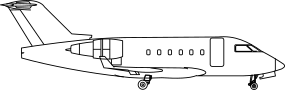
| Specification | Value |
|---|---|
| Manufacturer | Dassault |
| Category | Large jet |
| Range* | 5652 km 3052 NM |
| Cruise speed | 887 km/h 479 kts |
| Seats** | 8-12 |
| Suitcases | 12 |


* with IFR reserves
** in standard configuration
Aircraft Pictures

History
Dassault originally launched the Falcon 2000 programme as the Falcon X in 1989, before renaming it prior to entering service. The aircraft was designed to complement Dassault's existing Falcon lineup with enhanced performance and modern systems.
The Falcon 2000 made its first flight on March 4, 1993, beginning a comprehensive test programme. The aircraft received certification in 1994, setting the stage for production to commence in 1995.
The 2000 established the foundation for one of business aviation's most successful aircraft families. The original design featured twin-engine reliability, supercritical wing technology, and Dassault's renowned build quality, appealing to operators seeking long-range capability with operational efficiency.
The Falcon 2000 served as the base for numerous variants, including the 2000EX, 2000LX, 2000S, and 2000LXS. Since 1995, Dassault has built 675 Falcon 2000s, with close to 700 aircraft across all variants now in service worldwide. The programme's longevity demonstrates the enduring appeal of Dassault's design philosophy and engineering excellence.
Technical Specifications
General information
| Model name | Falcon 2000 |
|---|---|
| Manufacturer | Dassault Aviation |
| Aircraft category | large jet |
| ICAO Designator | F2TH |
| Start/End of Production | 1995 - 2007 |
| Number of pilot(s) | 2 |
Performances
| Range (with IFR reserves) | 3052 NM (5652 km) |
|---|---|
| Ferry range | 3130 NM (5797 km) |
| Cruise speed | 479 kts (887 km/h) |
| Max Operating Speed – VMO | 370 KIAS |
| Max Mach Operating Speed - MMO | Mach 0.87 |
| Long-Range Cruise Speed - LRC | 417 KTAS |
| Approach Speed | 113 kts |
| Takeoff Distance | 1640 m |
| Average Landing Distance | 792 m |
| Rate of Climb | 3700 ft/min |
| Service Ceiling | 47000 ft |
| Thrust | 5918 lbf |
Aircraft technology
| Engine type | Turbofan |
|---|---|
| Engine(s) | 2 x CFE738-1-1B |
| Avionics | Collins Pro Line 4 |
Dimensions and capacity
| Aircraft length | 20.23 m |
|---|---|
| Aircraft height | 7.11 m |
| Wing span | 21.38 m |
| Cabin height | 1.9 m (6.2 ft) |
| Cabin length | 9.8 m (32.2 ft) |
| Cabin width | 2.34 m (7.67 ft) |
| Baggage volume | 3.79 m3 |
| Seats (standard config) | 8-12 |
| Seats (max) | 19 |
| Suitcases | 12 |
| Carry-on luggage | 10 |
| Maximum TakeOff Weight - MTOW | 19414 kg |
| Maximum Landing Weight - MLW | 17826 kg |
| Fuel capacity | 9446 L |
FAQ
How does the Falcon 2000 compare to the Falcon 900?
The Falcon 2000 is a twin-engine jet with an NBAA IFR range of 5,652 km (3,130 nm) and a cruise speed of 887 km/h (479 kts). It was designed as a slightly smaller and more economical counterpart to the tri-engine Falcon 900, which in its latest Falcon 900LX version extends to 8,797 km (4,750 nm) at 878 km/h (474 kts). The Falcon 2000 is generally chosen for regional and medium-haul intercontinental flights, while the Falcon 900 family is better suited for longer missions requiring extra range, three-engine redundancy, and more cabin capacity.
How does the Falcon 2000 compare to the Gulfstream G550?
The Falcon 2000 has an NBAA IFR range of 5,652 km (3,130 nm) and cruises at 887 km/h (479 kts), making it well suited for regional and transcontinental flights. The Gulfstream G550, by contrast, offers a much longer NBAA IFR range of 12,501 km (6,750 nm) and cruises at 904 km/h (488 kts). It also carries more passengers, typically 14–16. While the G550 is chosen for nonstop intercontinental travel, the Falcon 2000 remains a more economical option for shorter intercontinental or regional missions.
How far can the Falcon 2000 fly on a charter flight?
The Falcon 2000 has an NBAA IFR range of 5,652 km (3,052 nm). This enables nonstop routes such as Paris to Dubai or London to Istanbul. While later versions like the Falcon 2000EX and 2000LX extend this range further, the original Falcon 2000 remains popular for regional and medium-haul intercontinental travel.
Is the Falcon 2000 still widely used for charter flights?
Yes. Even though production of the original Falcon 2000 ended in 2007, it remains active in charter fleets worldwide. Its 5,797 km (3,130 nm) range, wide cabin, and ability to access shorter airports still make it attractive for business and leisure travellers. Many aircraft have also been upgraded with modern avionics and Wi-Fi, keeping them competitive alongside newer jets.
Where does the Falcon 2000 fit within the Falcon 2000 family?
The Falcon 2000, introduced in the mid-1990s, was the foundation of the entire 2000 series. It offered a wide-body twin-engine design with an NBAA IFR range of 5,652 km (3,130 nm), making it practical for regional and some transcontinental flights. Later models such as the 2000EX, 2000LX, 2000S, and 2000LXS all evolved from this baseline, adding longer range, better aerodynamics, or improved runway performance.