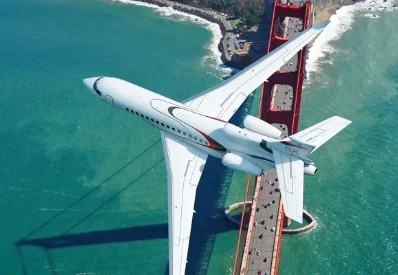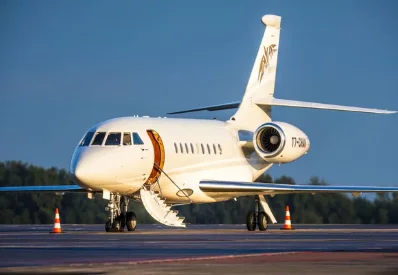
Dassault Falcon 2000LXS
The Dassault Falcon 2000LXS is the latest variant of the popular Falcon 2000 large jet and remains in production. From a technical standpoint, the twin-engine business jet is a scaled-down variant of the three-engine Falcon 900 with a shorter range. The popular aircraft has been produced since 1994 at the main plant of France's second-largest aircraft manufacturer after Airbus in Mérignac, near the Aéroport de Bordeaux - Mérignac (BOD).
Large jet
| Specification | Value |
|---|---|
| Manufacturer | Dassault |
| Category | Large jet |
| Range* | 7410 km 4000 NM |
| Cruise speed | 895 km/h 483 kts |
| Seats** | 10 |
| Suitcases | 12 |


* with IFR reserves
** in standard configuration
Aircraft Pictures


History

Dassault began developing the Falcon 2000 in 1989 to complement its portfolio of business jets. The goal was to build an efficient large aircraft that would live up to Dassault's reputation for excellence. The original Falcon 2000, which entered series production in 1994, was built as a smaller, twin-engine alternative to the three-engine Falcon 900.
In 2003, Dassault replaced the engines to achieve a longer range with comparable fuel consumption. The new model was called the 2000EX. The following year, the Falcon 2000EX EASy was developed, equipped with a new avionics suite. Pilots benefited from this innovation, thereby improving situational awareness in the cockpit with a reduced workload when flying.
In 2009, Dassault made an apparent adjustment with the addition of Aviation Partners' so-called blended winglets. Combined with other innovations, the 2000LX variant improved the fuel capacity, range and climb rate of the now-established large jet.
In 2013, the first examples of the Falcon 2000S were delivered. Most notable was its improved runway performance: It managed a significantly shorter take-off and landing runway than its predecessors. The fuel tank volume was also reduced, shortening its range by around 900 kilometres.
Also in 2013, the aircraft manufacturers also began production of the Falcon 2000LXS, which combined the best performance features of the 2000LX with those of the 2000S. The LXS offers the runway capabilities of the S model, but also does not sacrifice the long range of the 2000LX.
Due to its excellent range, a modified version of the 2000LXS is also to be used as a maritime reconnaissance aircraft by the French Navy under the name Albatros. Deliveries of the jets, some of which will be manufactured in India, are scheduled to begin in 2025.
Technical Specifications
General information
| Model name | Falcon 2000LXS |
|---|---|
| Manufacturer | Dassault Aviation |
| Aircraft category | large jet |
| ICAO Designator | F2TH |
| Start/End of Production | 2013 - Still in production |
| Number of pilot(s) | 2 |
Performances
| Range (with IFR reserves) | 4000 NM (7410 km) |
|---|---|
| Ferry range | 4200 NM (7778 km) |
| Cruise speed | 483 kts (895 km/h) |
| Max Operating Speed – VMO | 370 KIAS |
| Max Mach Operating Speed - MMO | Mach 0.86 |
| Long-Range Cruise Speed - LRC | 437 KTAS |
| Approach Speed | 105 kts |
| Takeoff Distance | 1425 m |
| Average Landing Distance | 689 m |
| Service Ceiling | 47000 ft |
| Thrust | 7000 lbf |
Aircraft technology
| Engine type | Turbofan |
|---|---|
| Engine(s) | 2 x Pratt & Whitney PW308C |
| Avionics | EASy II / IV |
Dimensions and capacity
| Aircraft length | 20.23 m |
|---|---|
| Aircraft height | 7.11 m |
| Wing span | 21.38 m |
| Cabin height | 1.88 m (6.17 ft) |
| Cabin length | 7.98 m (26.17 ft) |
| Cabin width | 2.34 m (7.67 ft) |
| Baggage volume | 3.7 m3 |
| Seats (standard config) | 10 |
| Seats (max) | 19 |
| Suitcases | 12 |
| Carry-on luggage | 10 |
| Maximum TakeOff Weight - MTOW | 19414 kg |
| Maximum Landing Weight - MLW | 17826 kg |
| Fuel capacity | 10042 L |
Advantages & Disadvantages
Advantages of a Falcon 2000LXS as a rental aircraft:

- Transatlantic range: With a range of 7410 kilometres, the Falcon 2000LXS allows comfortable travel from Europe to transatlantic destinations. Direct flights from Geneva, Frankfurt, or London City to the east coast of the United States are possible, as are private flights to Mumbai in India. Thanks to its improved short-haul performance compared to previous models, travellers also have access to smaller airports such as departure or destination airports.
- Powerful performance: In terms of performance, the French aircraft builders can benefit from their experience in building fighter aircraft. For example, the connection of the wings to the fuselage was taken directly from the Dassault military aircraft and is considered unique in the industry. Inside the luxury aircraft, it makes its performance felt through smooth and controlled flight behaviour even at high speed or in light turbulence
- Sophisticated cabin configuration: The cabin of the state-of-the-art business jet is equipped with the latest entertainment systems. It features a quiet, spacious, and modern cabin that can accommodate up to 10 passengers. The Falcon 2000LXS is typically equipped with two cabin zones for either productivity or in-flight entertainment value. The cabin ambience combines professionalism and exclusivity with cosiness and comfort.
- Short field takeoff and landing option: The modern jet has the ability to reach short and difficult runways that other jets avoid. One example is the short landing field at La Môle Airport in St. Tropez. Passengers benefit from a shortened overall travel time by covering a greater proportion of the distance in the fastest and most direct mode of transport.
- Global spread: Around 90 Falcon 2000LXS business jets are currently in operation worldwide: around 70 percent of them have their home base in North America and close to 30 percent in Europe. Especially for travel between Western Europe and the East Coast of the USA, acceptable availability of the large Falcon rental aircraft can be assumed.
Disadvantages of a Falcon 2000LXS as a rental aircraft:
- High acquisition costs: With a new price of around 35 million U.S. dollars, the popular Dassault Large Jet is no bargain. Even for used models, buyers still have to dig comparatively deep into their pockets: a five-year-old Falcon costs around 65 percent of its new price. However, the rental costs are at least slightly cushioned by efficient consumption and lower operating costs.
- Comparatively low penetration: With around 90 models sold, there is no guarantee that a suitable jet will be within reach at all times and in all places. The chances are better with technically and capacity-wise comparable alternatives: Both the Bombardier Challenger 650 and the G280 from Gulfstream are in circulation in larger numbers.

Overall, the decision to rent a Falcon 2000LXS is an excellent choice, especially for longer trips with multiple passengers. The long history of the Falcon series, with 7 civil variants, has allowed Dassault to continuously optimise the luxury jet without saying goodbye to long-standing proven features. Since its introduction, more than 600 aircraft of the series are in service.
With its transcontinental range, excellent short-haul performance, and luxurious cabin, the Falcon comes into its own, especially on long or long-distance flights. The interior of the French private jet is spacious, stylish, luxurious, and quiet. For travel to destinations less than 6000 kilometres away, the Dassault Falcon 2000S could be considered a comparable alternative with a shorter range.
The enthusiasm for the high-performance business jet is also shared by the industry press: in 2016, it was nominated by the renowned Rob Report in the "Best of the Best: Business Jets" category.
Where the Dassault Falcon 2000LXS flies most
Milan to Rome was the busiest Dassault Falcon 2000 route in 2025, with 388 flights. 46% of the family's charter flights worldwide touched Europe, the Middle East or North Africa. Istanbul leads with 1,439 movements, just ahead of Milan (1,394) and Rome (1,206).
Domestic shuttles explain the top three. In Istanbul, the Falcon 2000 mainly links Istanbul to Bodrum, Gaziantep, Muğla and Ankara. In Rome, it flew 12% of all charter movements, and a third of them were flights to Milan. Madrid is in the same situation, with 218 flights to Barcelona.
Billund, in Denmark, is the most unusual entry. The type flew 30% of all charter movements there, mainly to London, Budapest, Copenhagen and Paris. Nice is the most seasonal city on the list, with 53% of its movements between June and September.
Based on LunaJets analysis of ADS-B flight tracking data. Contains information from adsb.lol, made available under the Open Database License (ODbL). The figures cover take-offs and landings on commercial charter flights (Part 135 / CAT) in 2025, in Europe, the Middle East and North Africa. They include every version that shares the aircraft's type code, and a city needs at least 20 movements to be ranked.
Top Cities in 2025
For business trips in Italy, the Rome page covers the busy route to Milan. In northern Europe, private flights to Billund are a regular Falcon 2000 trip.
FAQ
Which airports can be served by a Falcon 2000LXS?
The Falcon 2000LXS is characterized by its excellent short-haul performance. That's why it lands at smaller airports such as London City, Geneva, Lugano, or La Môle Saint-Tropez just as reliably as at major commercial airports.
How many Falcon 2000LXS jets have been sold so far?
A total of 96 Falcon 2000LXS have been produced to date. If you also count the predecessor models of the Falcon 2000 series, you get a total of 607 sold.
Who owns a Falcon 2000LXS?
Mainly because of its size, the Falcon 2000LXS is often not the first choice when it comes to private individuals acquiring a private jet. It is known that the Indian manager Ratan Tata owns a copy of the spacious luxury jet. The midsize jet, on the other hand, is extremely popular with government agencies. Owners include the defense ministries or police forces of France (air & space forces), Japan (coast guard), South Korea (air force), and Thailand (police).
How does the Falcon 2000LXS differ from the Bombardier Challenger 650?
The Falcon 2000LXS and the Challenger 650 are very similar in many respects: both aircraft have comparable range, acquisition costs, and taxiin dimensions. In terms of cruising speed, the Challenger 650 is just ahead. However, the higher performance is also reflected in fuel consumption: the Challenger burns around 15% more fuel per hour. In terms of luggage capacity, the Falcon scores again, offering around half a cubic metre more space for luggage. All in all, however, both models are excellent travel options in the super-midsize jet segment.
How much does a Falcon 2000LXS cost?
The average price for a used Dassault Falcon 2000LXS is around $23.8 million. The new price according to the list of basic equipment is currently 35.1 million US dollars.
How does the Falcon 2000LXS compare to the Falcon 8X?
The Falcon 2000LXS flies up to 7,408 km (4,000 nm), while the Falcon 8X extends range to 11,945 km (6,450 nm). The 2000LXS seats 8–10 passengers, compared to 12–14 on the 8X, and cruises at about 894 km/h (483 kts) versus the 8X’s 911 km/h (492 kts). In terms of performance, the 2000LXS requires about 1,425 m (4,675 ft) for takeoff and 689 m (2,260 ft) for landing, while the 8X needs 1,792 m (5,880 ft) for takeoff and 677 m (2,220 ft) for landing. The Falcon 8X is Dassault’s flagship ultra-long-range jet, offering a larger and more premium cabin for nonstop global travel. The 2000LXS, by contrast, is optimised for efficiency on shorter intercontinental missions and provides access to airports with shorter runways.
Can the Falcon 2000LXS use smaller airports?
Yes. With aerodynamic improvements and enhanced short-field capability, the Dassault Falcon 2000LXS can take off and land on runways shorter than many comparable jets require. This enables access to secondary airports close to city centres or resorts, reducing ground travel times. It is also certified for steep approaches and approved to operate at London City Airport (LCY), one of Europe’s most demanding business aviation hubs.
How does the Falcon 2000LXS compare to the Embraer Praetor 600?
The Dassault Falcon 2000LXS flies about 4,000 nautical miles (7,408 km) and typically carries 8–10 passengers in a wide-body cabin. The Embraer Praetor 600 is a super-midsize jet with a range of around 4,018 nautical miles (7,441 km), seating 8 passengers (standard configuration). While the Praetor 600 provides excellent efficiency and advanced avionics in a smaller cabin, the Falcon 2000LXS offers more cabin width and comfort, along with strong short-field capability for accessing airports with limited runway length.
How far can the Falcon 2000LXS fly on a charter flight?
The Dassault Falcon 2000LXS has an NBAA IFR range of 7,408 km (4,000 nm) and cruises at about 894 km/h (483 kts). This permits nonstop intercontinental flights such as London–New York or Paris–Dubai. Range varies with weather, payload, and routing, but the aircraft is widely chosen for transatlantic travel where both performance and comfort are important.
Where does the Falcon 2000LXS fit within the Falcon 2000 family?
Introduced in 2013, the Falcon 2000LXS is the flagship of the 2000 family. It combines the Falcon 2000LX’s winglets and long-range capability (7,408 km / 4,000 nm) with the Falcon 2000S’s short-field performance. This balance makes the 2000LXS the most versatile variant, able to link intercontinental city pairs while still operating at airports with shorter runways.