


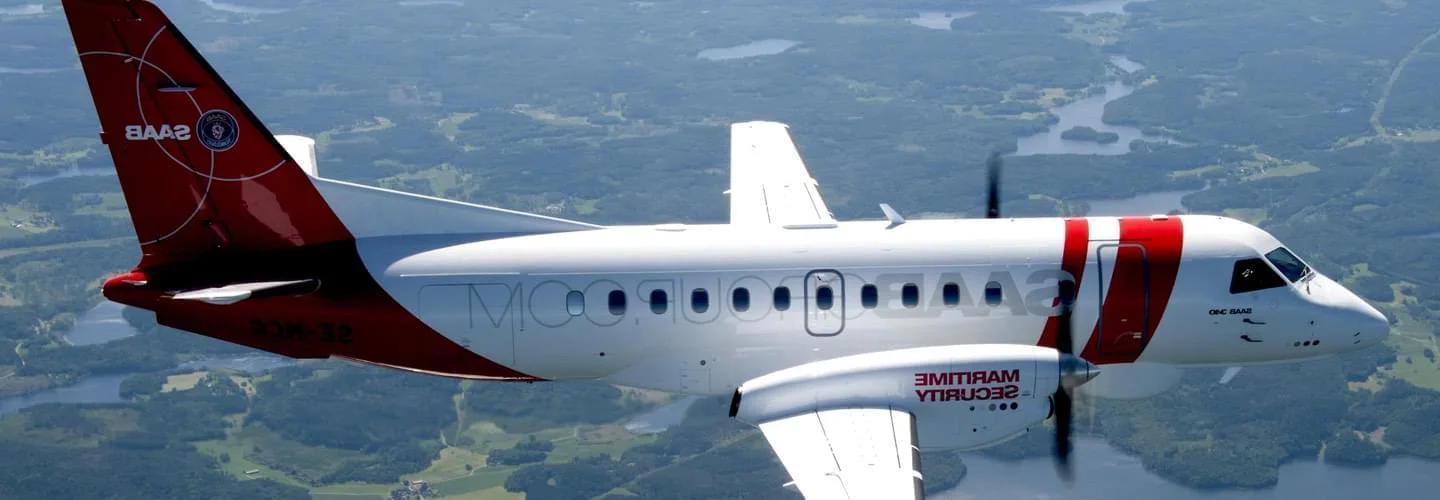
Saab 340
Saab began production of the 340 in partnership with Fairchild Aircraft in 1983 and the aircraft quickly became a popular turboprop airliner, used by a wide variety of different civil operators and commercial airlines. The Saab 340 offers similar performance capabilities to the Dornier 328 turboprop and is also of a similar size, seating up to 33 passengers in an economy configuration, although variations to this formation exist, with some aircraft having 34 or 36 seats. Being a turboprop-powered aircraft, the Saab 340 has limited range, restricting it to short-haul flights. With a large capacity and excellent price, the Saab 340 represents a great solution to short-haul journey requirements.
Turboprop airliner

| Specification | Value |
|---|---|
| Manufacturer | Saab Ab |
| Category | Turboprop airliner |
| Range* | 1732 km 935 NM |
| Cruise speed | 522 km/h 282 kts |
| Seats** | 33-34 |
| Suitcases | 30 |


* with IFR reserves
** in standard configuration
History
The Saab 340 was developed as a 30-seat regional airliner in collaboration with Fairchild, first flying in 1983. The aircraft was designed to serve short to medium-haul routes with twin-turboprop efficiency and reliability.
The Saab 340 entered service in 1984 and became popular with regional airlines worldwide. The aircraft featured modern avionics and efficient turboprop engines that provided excellent fuel economy for regional operations.
Later variants included the 340B with more powerful engines and the 340A baseline model. The aircraft series established Saab's reputation in commercial aviation beyond its military aircraft heritage.
Production continued through the 1990s, with the aircraft serving operators requiring reliable regional transport. The Saab 340 demonstrated Swedish engineering excellence and became an important stepping stone for the company's later involvement in larger aircraft programmes through partnerships and acquisitions.
Technical Specifications
General information
| Model name | Saab 340 |
|---|---|
| Manufacturer | Saab |
| Aircraft category | turboprop airliner |
| ICAO Designator | SF34 |
| Start/End of Production | 1984 - 1999 |
| Number of pilot(s) | 2 |
Performances
| Range (with IFR reserves) | 935 NM (1732 km) |
|---|---|
| Ferry range | 1600 NM (2963 km) |
| Cruise speed | 282 kts (522 km/h) |
| Max Operating Speed – VMO | 250 KIAS |
| Long-Range Cruise Speed - LRC | 252 KTAS |
| Approach Speed | 120 kts |
| Takeoff Distance | 1285 m |
| Average Landing Distance | 1030 m |
| Rate of Climb | 2010 ft/min |
| Service Ceiling | 25000 ft |
| Thrust | 1750 shp |
Aircraft technology
| Engine type | Turboprop |
|---|---|
| Engine(s) | 2 x General Electric CT7 turboprops |
| Avionics | Rockwell Collins APS-85 autopilot, EFIS-85 / EFD-86 CRT, AHS-85 AHRS, Pro Line II |
Dimensions and capacity
| Aircraft length | 19.73 m |
|---|---|
| Aircraft height | 6.97 m |
| Wing span | 21.44 m |
| Cabin height | 1.83 m (6.0 ft) |
| Cabin length | 10.39 m (34.08 ft) |
| Cabin width | 2.16 m (7.08 ft) |
| Baggage volume | 8.35 m3 |
| Seats (standard config) | 33-34 |
| Seats (max) | 37 |
| Suitcases | 30 |
| Carry-on luggage | 30 |
| Maximum payload | 3400 kg |
| Maximum TakeOff Weight - MTOW | 13155 kg |
| Maximum Landing Weight - MLW | 12925 kg |
| Fuel capacity | 3220 L |
FAQ
How many passengers can the Saab 340 accommodate, and what seating configurations are available?
The Saab 340 typically seats up to 33 passengers in a standard economy configuration, though variations exist with some aircraft configured for 34 or 37 seats depending on the operator's requirements. The aircraft offers a spacious cabin with a height of 1.8 metres, length of 10.4 metres, and width of 2.2 metres, providing reasonable comfort for regional travel.
How does the Saab 340 compare to the Dornier 328 turboprop in terms of performance and capacity?
The Saab 340 offers similar performance capabilities to the Dornier 328 turboprop and is of comparable size. Both aircraft serve the regional turboprop market effectively, with the Saab 340 seating up to 33 passengers compared to the Dornier 328's typical configuration. The Saab 340 has proven reliability through widespread use by civil operators and commercial airlines, whilst both aircraft represent viable solutions for regional transportation needs requiring turboprop efficiency.
What is the maximum cruise speed of the Saab 340, and how does this compare to similar turboprop airliners?
The Saab 340 achieves a maximum cruise speed of 524 km/h (283 knots), which places it competitively amongst turboprop airliners of similar size. This speed is faster than the Dornier 328 turboprop (620 km/h). Whilst jet-powered aircraft cruise significantly faster, the Saab 340's speed is well-suited for short to medium-haul regional operations.
What is the operational range of the Saab 340, and what types of routes is it best suited for?
The Saab 340 has an NBAA IFR range of 1,732 km (935 nautical miles) and a ferry range of 2,963 km (1,600 nautical miles). This range capability restricts the aircraft to short-haul flights, making it ideal for regional routes such as connecting smaller cities to major hubs or serving island communities. The limited range is typical for turboprop airliners of this class, designed for frequent, shorter sectors rather than long-distance travel.
What makes the Saab 340 particularly suitable for regional airline operations, and what are its main operational limitations?
The Saab 340's strengths lie in its large passenger capacity combined with excellent value, making it an attractive solution for short-haul journey requirements. Developed in partnership with Fairchild Aircraft and entering service in 1984, the aircraft established a reputation for reliability through widespread adoption by regional airlines worldwide. However, being turboprop-powered, it has limited range and cruise speed compared to jet aircraft, restricting its use to regional routes. Production ran from 1984 to 1999, powered by General Electric CT7 turboprop engines.