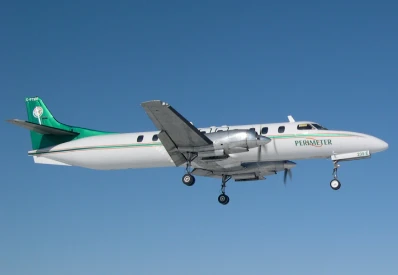
Fairchild Dornier 228
The Dornier 228 is a turboprop-powered airliner that was launched over 30 years ago, during which time it has repeatedly been modified and upgraded. The most recent version entered into service in 2009 and features a wide range of improvements from the previous 228, including a brand-new engine and 5-blade propeller. It is smaller than some other aircraft in its category of turboprop airliners but still comfortably seats up to 19 passengers in a standard configuration. With a range of over 1,000 km, it is ideal for groups wishing to complete short-haul flights at an excellent price.
Turboprop airliner

| Specification | Value |
|---|---|
| Manufacturer | Fairchild Dornier |
| Category | Turboprop airliner |
| Range* | 1037 km 560 NM |
| Cruise speed | 413 km/h 223 kts |
| Seats** | 19 |
| Suitcases | 19 |


* with IFR reserves
** in standard configuration
Aircraft Pictures

History
The Fairchild Dornier 228 originated as a German-developed twin-engine turboprop designed for short-haul regional operations. Fairchild Dornier continued production of this versatile aircraft after acquiring Dornier's aviation assets.
The Do 228 was first developed by Dornier in the early 1980s as a 19-seat regional aircraft featuring advanced composite construction and reliable turboprop engines. The aircraft gained recognition for its ability to operate from short, unpaved airstrips.
Fairchild Dornier maintained production standards while adapting the aircraft for various roles, including passenger transport, cargo operations, and specialized missions. The twin-engine configuration provided operational safety margins important for regional operations.
The aircraft's robust design and operational flexibility made it suitable for challenging environments worldwide. The Dornier 228 served operators requiring reliable transportation to remote destinations while maintaining low operating costs typical of turboprop aircraft.
Technical Specifications
General information
| Model name | Dornier 228 |
|---|---|
| Manufacturer | Fairchild Dornier |
| Aircraft category | turboprop airliner |
| ICAO Designator | D228 |
| Start/End of Production | 1982 - Still in production |
| Number of pilot(s) | 2 |
Performances
| Range (with IFR reserves) | 560 NM (1037 km) |
|---|---|
| Ferry range | 1276 NM (2363 km) |
| Cruise speed | 223 kts (413 km/h) |
| Max Operating Speed – VMO | 185 KIAS |
| Long-Range Cruise Speed - LRC | 178 KTAS |
| Approach Speed | 85 kts |
| Takeoff Distance | 792 m |
| Average Landing Distance | 449 m |
| Rate of Climb | 1637 ft/min |
| Service Ceiling | 25000 ft |
| Thrust | 776 shp |
Aircraft technology
| Engine type | Turboprop |
|---|---|
| Engine(s) | 2 x Honeywell TPE331-10 |
| Avionics | Glass Cockpit / Universal UNS-1 |
Dimensions and capacity
| Aircraft length | 16.56 m |
|---|---|
| Aircraft height | 4.86 m |
| Wing span | 16.97 m |
| Cabin height | 1.55 m (5.1 ft) |
| Cabin length | 7.08 m (23.25 ft) |
| Cabin width | 1.35 m (4.42 ft) |
| Baggage volume | 3.49 m3 |
| Seats (standard config) | 19 |
| Seats (max) | 19 |
| Suitcases | 19 |
| Carry-on luggage | 19 |
| Maximum payload | 2661 kg |
| Maximum TakeOff Weight - MTOW | 6400 kg |
| Maximum Landing Weight - MLW | 6100 kg |
| Fuel capacity | 2386 L |
FAQ
How many passengers can the Dornier 228 accommodate?
The Dornier 228 accommodates 15-19 passengers in its standard configuration, with a maximum capacity of 19 passengers. The cabin measures 6.31 metres in length, 1.34 metres in width, and 1.55 metres in height, providing adequate space for short-haul regional operations whilst maintaining the compact dimensions necessary for accessing smaller airports.
Is the Dornier 228 faster than the Saab 340?
No, the Dornier 228 is slower than the Saab 340, with the Dornier 228 cruising at 413 km/h (223 knots) and the Saab cruise speed being 524 km/h (283 knots). The performance difference between these aircraft is almost 100 km/h, the Saab 340 is clearly faster that the Dornier 228.
What is the cruising speed of the Dornier 228?
The Dornier 228 cruises at 413 km/h (223 knots), positioning it as a capable regional turboprop. This speed makes the aircraft well-suited for short-haul regional routes where efficiency and cost-effectiveness take priority over maximum speed, allowing operators to maintain competitive schedules whilst benefiting from the lower operating costs typical of turboprop aircraft.
What is the maximum range of the Dornier 228?
The Dornier 228 offers an NBAA IFR range of 1,037 km (560 nautical miles), with a ferry range extending to 2,363 km (1,276 nautical miles). This range capability makes it ideal for connecting regional destinations such as London to Barcelona or Amsterdam to Rome, providing reliable service for routes that larger aircraft cannot serve economically.
What makes the Dornier 228 suitable for challenging airports?
The Dornier 228 gained recognition for its ability to operate from short, unpaved airstrips, making it particularly valuable for routes to remote destinations. Its twin-engine turboprop configuration provides operational safety margins essential for challenging environments, whilst the robust design allows reliable service to airports that larger aircraft cannot access, explaining its continued use in specialized regional operations worldwide.