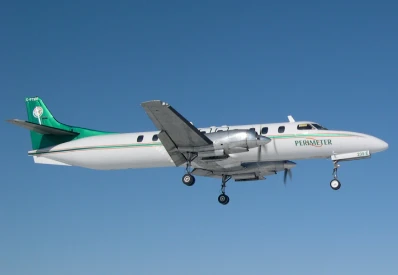
Fairchild Dornier 328
The Dornier 328 turboprop is a variant of Dornier's 328 series, which also features the Dornier 328JET and the Dornier 328 Executive. As its name suggests, this version belongs to the category of turboprop airliners and is, therefore, not capable of as great a range as the other members of the 328 family, although it can still undertake uninterrupted flights of nearly 2000 km. It is considerably larger than the Dornier 228 turboprop airliner and can accommodate up to 32 passengers in its standard seating configuration. This aircraft is extremely reliable and affordable, as well as being practical, rendering it perfect for large groups looking to make short-haul private flights.
Turboprop airliner

| Specification | Value |
|---|---|
| Manufacturer | Fairchild Dornier |
| Category | Turboprop airliner |
| Range* | 1852 km 1000 NM |
| Cruise speed | 620 km/h 335 kts |
| Seats** | 30 |
| Suitcases | 30 |


* with IFR reserves
** in standard configuration
Aircraft Pictures

History
The Fairchild Dornier 328 emerged as a 30-seat regional turboprop designed for short to medium-haul operations. Originally developed by Dornier in Germany, the aircraft was continued by Fairchild Dornier following the company's acquisition of Dornier's assets.
The Do 328 made its first flight in the early 1990s, featuring modern avionics and efficient Pratt & Whitney Canada PW119 engines. The aircraft was designed to bridge the gap between smaller commuter aircraft and larger regional jets.
Production included both turboprop and jet variants, with the turboprop version offering fuel efficiency and operational economy for regional routes. The aircraft featured a comfortable cabin and baggage compartment suitable for passenger airline operations.
The 328 family demonstrated Fairchild Dornier's commitment to the regional aircraft market, providing airlines with reliable, cost-effective transportation solutions. The aircraft served operators worldwide requiring versatile performance for diverse route structures and operating conditions.
Technical Specifications
General information
| Model name | Dornier 328 |
|---|---|
| Manufacturer | Fairchild Dornier |
| Aircraft category | turboprop airliner |
| ICAO Designator | D328 |
| Start/End of Production | 1993 - 2000 |
| Number of pilot(s) | 2 |
Performances
| Range (with IFR reserves) | 1000 NM (1852 km) |
|---|---|
| Ferry range | 1850 NM (3426 km) |
| Cruise speed | 335 kts (620 km/h) |
| Max Operating Speed – VMO | 202 KIAS |
| Long-Range Cruise Speed - LRC | 281 KTAS |
| Approach Speed | 110 kts |
| Takeoff Distance | 1000 m |
| Average Landing Distance | 645 m |
| Rate of Climb | 2060 ft/min |
| Service Ceiling | 31000 ft |
| Thrust | 2180 shp |
Aircraft technology
| Engine type | Turboprop |
|---|---|
| Engine(s) | 2 x Pratt & Whitney Canada PW119B |
| Avionics | Honeywell Primus 2000 EFIS |
Dimensions and capacity
| Aircraft length | 21.28 m |
|---|---|
| Aircraft height | 7.24 m |
| Wing span | 20.98 m |
| Cabin height | 1.89 m (6.2 ft) |
| Cabin length | 10.32 m (33.83 ft) |
| Cabin width | 2.19 m (7.2 ft) |
| Baggage volume | 6.4 m3 |
| Seats (standard config) | 30 |
| Seats (max) | 33 |
| Suitcases | 30 |
| Carry-on luggage | 30 |
| Maximum payload | 3739 kg |
| Maximum TakeOff Weight - MTOW | 13990 kg |
| Maximum Landing Weight - MLW | 13230 kg |
| Fuel capacity | 3416 L |
FAQ
Is the Dornier 328 larger than the Saab 340?
Yes, the Dornier 328 can accommodate up to 33 passengers compared to the Saab 340's typical 33-36 passenger capacity. The Dornier 328 offers comparable seating whilst providing the reliability and operational economy that made it popular with regional carriers worldwide during its production run.
How many passengers can the Dornier 328 accommodate?
The Dornier 328 can accommodate up to 33 passengers in its standard seating configuration. This capacity makes it considerably larger than the Dornier 228 and positions it as an excellent choice for airlines operating medium-density regional routes where passenger comfort and operational efficiency are priorities.
What engines power the Dornier 328, and how do they contribute to its operational efficiency?
The Dornier 328 is powered by efficient Pratt & Whitney Canada PW119 engines, which provide excellent fuel efficiency and operational economy for regional routes. These turboprop engines make the aircraft extremely reliable and affordable to operate, contributing to its reputation as a practical solution for airlines requiring versatile performance across diverse route structures and operating conditions.
What is the maximum range of the Dornier 328, and which city pairs can it connect?
The Dornier 328 can undertake uninterrupted flights of nearly 2,000 km, making it ideal for regional connections. This range allows the aircraft to connect city pairs such as London to Istanbul or Madrid to Warsaw, providing excellent connectivity for European regional routes whilst maintaining operational efficiency.
What is the cruising speed of the Dornier 328?
The Dornier 328 cruises at 620 km/h (335 knots), which provides efficient performance for regional routes. This speed makes it well-suited for short to medium-haul operations, allowing airlines to maintain competitive schedules on routes such as Munich to Vienna or Amsterdam to Copenhagen.