


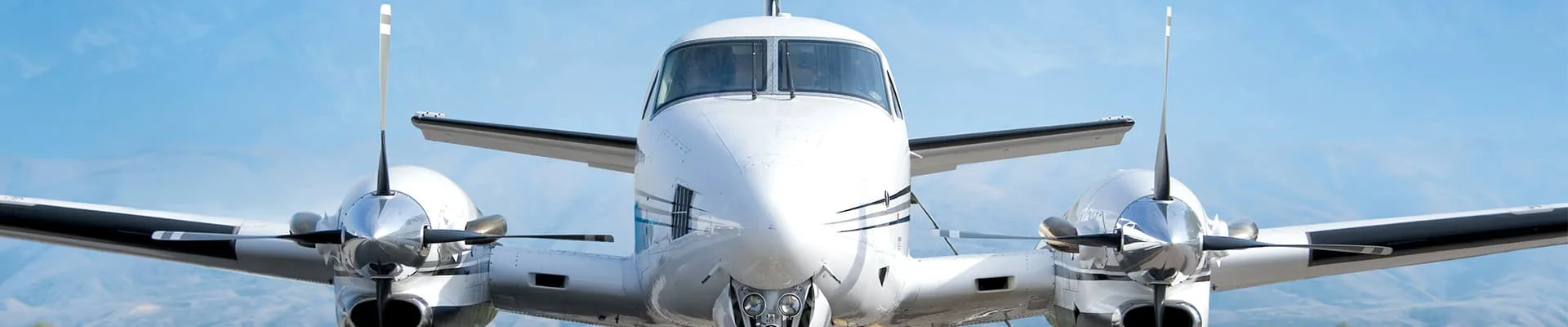

Beechcraft King Air C90GTx
The King Air range entered into service more than 45 years ago and has since been known for its durability, reliability and affordability. After a series of upgrades over the years, the King Air 90 GTx was launched in July 2009.
It was designed by Beechcraft to replace the C90GTi, and the addition of sleek winglets improves climb and cruise speed, as well as boosting fuel efficiency and performance. Its range has been increased by more than 20%, taking you even further than before - that's 903 nm at high speed with four adults on board. Although it is the smallest of the King Air range, it still comfortably accommodates up to 7 passengers.
The cockpit features top-of-the-range turbulence detection and avionics systems, usually found on larger aircraft with even larger price tags. Adding to the appeal of this excellent turboprop aircraft is its ability to land where many jets can't. Overall, this petite aircraft is packed with big jet features and offers an excellent range and fuel efficiency.
Turboprop

| Specification | Value |
|---|---|
| Manufacturer | Beechcraft |
| Category | Turboprop |
| Range* | 1672 km 903 NM |
| Cruise speed | 500 km/h 270 kts |
| Seats** | 5 |
| Suitcases | 2 |


* with IFR reserves
** in standard configuration
Aircraft Pictures


History
The King Air C90GTx traces its lineage to the original Model 90, which Beechcraft launched in July 1963 as a turboprop upgrade to the piston-engine Queen Air. The first Model 90 flew on January 24, 1964, powered by two Pratt & Whitney Canada PT6A-6 engines.
The C90 series evolved through multiple variants over five decades. Beechcraft introduced the C90GT in 2005 with more powerful PT6A-135A engines, followed by the C90GTi in 2007 featuring Rockwell Collins ProLine 21 avionics.
The C90GTx variant arrived in 2010 as the latest evolution, adding winglets and increased maximum takeoff weight for full-fuel payload flexibility. The aircraft retained the proven PT6A-135A engines, each producing 550 shaft horsepower, though the engines are capable of 750 horsepower but limited for this application.
The C90GTx represents over 50 years of continuous development of the PT6A engine family, which by 2016 had accumulated more than 400 million flight hours with an exceptional in-flight shutdown rate of just 1 per 651,126 hours. This reliability record helped establish the King Air 90 series as a cornerstone of business aviation worldwide.
Technical Specifications
General information
| Model name | King Air C90GTx |
|---|---|
| Manufacturer | Beechcraft |
| Aircraft category | turboprop |
| ICAO Designator | BE9L |
| Start/End of Production | 2010 - 2021 |
| Number of pilot(s) | 1 |
Performances
| Range (with IFR reserves) | 903 NM (1672 km) |
|---|---|
| Ferry range | 1260 NM (2334 km) |
| Cruise speed | 270 kts (500 km/h) |
| Max Operating Speed – VMO | 226 KIAS |
| Long-Range Cruise Speed - LRC | 204 KTAS |
| Approach Speed | 100 kts |
| Takeoff Distance | 605 m |
| Average Landing Distance | 640 m |
| Rate of Climb | 1953 ft/min |
| Service Ceiling | 30000 ft |
| Thrust | 550 shp |
Aircraft technology
| Engine type | Turboprop |
|---|---|
| Engine(s) | 2 x Pratt & Whitney Canada PT6A-135A |
| Avionics | Rockwell Collins Pro Line Fusion |
Dimensions and capacity
| Aircraft length | 10.82 m |
|---|---|
| Aircraft height | 4.34 m |
| Wing span | 16.36 m |
| Cabin height | 1.45 m (4.8 ft) |
| Cabin length | 3.84 m (12.6 ft) |
| Cabin width | 1.37 m (4.5 ft) |
| Baggage volume | 1.37 m3 |
| Seats (standard config) | 5 |
| Seats (max) | 8 |
| Suitcases | 2 |
| Carry-on luggage | 4 |
| Maximum payload | 958 kg |
| Maximum TakeOff Weight - MTOW | 4756 kg |
| Maximum Landing Weight - MLW | 4460 kg |
| Fuel capacity | 1454 L |
FAQ
Can the King Air C90GTx use short or regional airports like Gstaad?
Yes, the King Air C90GTx is designed for short-field performance, giving access to regional airports that jets often cannot reach. At Gstaad-Saanen Airport, for example, the 1,400-metre runway is more than sufficient for safe operations, although altitude and mountain terrain can affect performance. This capability makes the aircraft ideal for travellers who want to land closer to alpine resorts or remote destinations
How does the King Air C90GTx compare to the King Air F90?
The King Air F90, introduced in the late 1970s, was a crossover design that combined the fuselage of the C90 with the T-tail and wings of the B200. While innovative at the time, it is now dated, with older avionics and less efficient performance. The King Air C90GTx, launched in 2010, comes with PT6A-135A engines, composite winglets, and Pro Line Fusion avionics, along with a quieter cabin. It delivers stronger climb rates, improved fuel economy, and a higher level of passenger comfort than the legacy F90.
Where is the King Air C90GTx most often used?
The King Air C90GTx is widely used for regional travel where access to smaller airports is a priority. In Europe, it connects cities such as Geneva, Milan, and Munich with nearby alpine airports like Saanen or Sion. In the United States, it serves popular regional routes including Dallas–Houston or Chicago–Nashville, and is often chosen for flights into smaller secondary airports that jets cannot access.
How far can the King Air C90GTx fly without refuelling?
The King Air C90GTx has an NBAA IFR range of 2,134–2,446 km (1,152–1,321 nm) on a single tank, depending on passenger load, baggage, and weather conditions. This makes it ideal for short- to mid-haul routes, such as London–Ibiza or New York–Chicago, without the need for a fuel stop.


