



Boeing BBJ
The Boeing Business Jet (BBJ) is the mainstay of the Boeing corporate offering, providing an extraordinarily luxurious service to its passengers. The interior is magnificently spacious, the cabin being shorter, wider and taller than the Lineage 1000, giving a greater overall floor area. Boeing offers a wide variety of interior layouts, depending on your preferences, but these generally consist of 5 separate sleeping and living areas, including an exquisite master bedroom suite, a conference/dining room, an office and opulent lounge areas, as well as luxury bathrooms and a fully equipped kitchen, capable of producing the finest cuisine.
The BBJ also provides excellent performance, with a recently improved fuel economy and a greater range than both the Lineage and ACJ320, largely thanks to its intelligent design and hugely powerful engines. State-of-the-art technology means that the BBJ can perform to this high standard, taking you on extensive trans-continental journeys, while maintaining a silent and steady cabin, allowing you to relax in serenity and comfort. Boeing is constantly updating their BBJs, adding fuel tanks to increase the range or upgrading technology to improve efficiency so that this aircraft will consistently offer an amazing combination of incredible performance and unbeatable comfort.
VIP Airliner
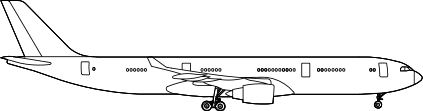
| Specification | Value |
|---|---|
| Manufacturer | Boeing |
| Category | VIP Airliner |
| Range* | 11482 km 6200 NM |
| Cruise speed | 870 km/h 470 kts |
| Seats** | 18-19 |
| Suitcases | 32 |


* with IFR reserves
** in standard configuration
Aircraft Pictures


History
Boeing entered the VIP airliner market in 1996 when company president Phil Condit and General Electric CEO Jack Welch announced a joint venture to develop the Boeing Business Jet. The programme responded to market demand for larger business aircraft with ranges exceeding 6,000 miles.
Based on the 737-700 Next Generation platform, the first BBJ rolled out on July 26, 1998, and completed its maiden flight on September 4, 1998. The aircraft entered service in 1999, with the first customer delivery completed in October 1998.
The original BBJ provided the foundation for Boeing's business aviation family, combining the proven reliability of commercial 737 systems with luxury VIP interiors. The aircraft offered transcontinental range capabilities and access to airports unavailable to larger commercial airliners.
Boeing later rebranded the original aircraft as the BBJ1 when the BBJ2 and BBJ3 variants joined the family. Over 260 BBJ aircraft across all variants have been delivered since the programme began, establishing Boeing's position in the VIP airliner segment alongside the traditional business jet manufacturers.
Technical Specifications
General information
| Model name | BBJ |
|---|---|
| Manufacturer | Boeing |
| Aircraft category | VIP airliner |
| ICAO Designator | B737 |
| Start/End of Production | 1998 - 2021 |
| Number of pilot(s) | 2-4 |
Performances
| Range (with IFR reserves) | 6200 NM (11482 km) |
|---|---|
| Ferry range | 6285 NM (11640 km) |
| Cruise speed | 470 kts (870 km/h) |
| Max Operating Speed – VMO | 340 KIAS |
| Max Mach Operating Speed - MMO | Mach 0.82 |
| Long-Range Cruise Speed - LRC | 452 KTAS |
| Approach Speed | 137 kts |
| Takeoff Distance | 1855 m |
| Average Landing Distance | 1370 m |
| Rate of Climb | 3100 ft/min |
| Service Ceiling | 41000 ft |
| Thrust | 27300 lbf |
Aircraft technology
| Engine type | Turbofan |
|---|---|
| Engine(s) | 2 x CFM International CFM56-7B27 / LEAP-1B |
| Avionics | Honeywell Primus Epic / Rockwell Collins HGS-4000 |
Dimensions and capacity
| Aircraft length | 33.6 m |
|---|---|
| Aircraft height | 12.5 m |
| Wing span | 35.8 m |
| Cabin height | 2.20 m (7.25 ft) |
| Cabin length | 24.13 m (79.2 ft) |
| Cabin width | 3.54 m (11.58 ft) |
| Baggage volume | 18.1 m3 |
| Seats (standard config) | 18-19 |
| Seats (max) | 56-63 |
| Suitcases | 32 |
| Maximum payload | 16420 kg |
| Maximum TakeOff Weight - MTOW | 77564 kg |
| Maximum Landing Weight - MLW | 66361 kg |
| Fuel capacity | 26025 L |
Where the Boeing BBJ flies most
The Boeing Business Jet (BBJ) flies mainly in this part of the world: 86% of its charter flights worldwide started or ended in Europe, the Middle East or North Africa in 2025.
One city dominates. Abu Dhabi recorded 871 movements, more than three times Dubai in 2nd place (263). The BBJ flew 19% of all commercial charter movements in Abu Dhabi, mostly from Zayed International rather than the smaller Al Bateen business airport. From there, the most frequent destinations were Dubai, Rabat, London, Geneva and Jeddah. Rabat ranks 4th for this reason, with half of its 107 movements linked to Abu Dhabi.
Long trips are the norm. 41% of the BBJ's flights in the region covered more than 3,000 km. In Europe, London, Geneva and Nice are busiest in summer: 62% to 77% of their BBJ movements took place between June and September.
Based on LunaJets analysis of ADS-B flight tracking data. Contains information from adsb.lol, made available under the Open Database License (ODbL). The figures cover take-offs and landings on commercial charter flights (Part 135 / CAT) in 2025, in Europe, the Middle East and North Africa. They include every version that shares the aircraft's type code, and a city needs at least 20 movements to be ranked.
Top Cities in 2025
Most BBJ trips in this region start or end in the Gulf. The Abu Dhabi page and the guide to flying to Rabat give prices and airport details for a group trip on a large aircraft.
FAQ
Can a BBJ access all airports, or are there runway restrictions?
Because the Boeing Business Jet is derived from the Boeing 737, it requires longer runways than smaller private jets. In practice, this means it is best suited for major international airports or well-equipped regional hubs, rather than short-runway destinations. Typical take-off distance is around 5,000–6,000 feet (≈1,500–1,800 metres), depending on weight and conditions. While this still allows access to hundreds of airports worldwide, it does limit operations at some smaller airfields that can accommodate light and midsize jets.
How far can a Boeing Business Jet (BBJ) fly without refuelling?
The Boeing Business Jet (BBJ) has an NBAA IFR range of 11,482 km (6,200 nm) with auxiliary fuel tanks. This means it can connect major intercontinental city pairs nonstop — for example, London to Los Angeles or Paris to Tokyo — depending on passenger load, baggage, and prevailing winds.
What is the difference between the BBJ1 and the BBJ Max series?
The BBJ1 was the first Boeing Business Jet, introduced in the late 1990s and based on the 737-700 airframe with the stronger wings and landing gear of the 737-800. It set the standard for VIP airliner travel with an NBAA IFR range of 11,482 km (6,200 nm). The BBJ Max series, introduced in the late 2010s, uses updated 737 Max airframes with more efficient LEAP-1B engines, improved aerodynamics, and additional fuel capacity. Depending on the variant, the BBJ Max offers a range of up to 12,220 km (6,600 nm) — giving it longer nonstop capability than the BBJ1. Cabin space is broadly similar, but the Max versions also feature lower fuel burn and reduced emissions, making them attractive for modern charter operations.
How does the BBJ compare to other large private jets like the Airbus ACJ?
The Boeing Business Jet and the Airbus Corporate Jet are both derived from commercial airliners, offering far more space than traditional private jets. The BBJ generally provides a slightly longer range — 11,373 km (6,141 nm) NBAA IFR with auxiliary fuel tanks — making it well suited to nonstop intercontinental routes. The ACJ, on the other hand, offers a wider cabin cross-section, which allows for more floor space and layout flexibility. For charter clients, the final choice often depends on the individual aircraft available, as every cabin is customised and no two layouts are alike.


